 Introducing iCallify Built by ASTPP’s Engineering Team to Power Modern Contact Centers

Quick Summary: Choosing the right VoIP billing platform in 2026 requires evaluating billing accuracy, real-time charging, automation, scalability, integrations, reporting, and support. This guide outlines essential factors telecom businesses should consider when comparing platforms and selecting a solution aligned with their operational needs.
Choosing the right VoIP billing platform in 2026 is one of the most consequential decisions a telecom operator can make. The global VoIP market is expanding fast. According to Grand View Research, it was valued at USD 44.99 billion in 2023 and is projected to grow at a CAGR of 12.9% through 2030. With that kind of growth comes sharper competition, thinner margins, and zero tolerance for billing inaccuracies.
Whether you are launching a new ITSP, scaling a wholesale VoIP carrier operation, or migrating away from a legacy telecom billing system, your billing platform is the financial backbone of your entire business. A wrong choice can lead to uncollected CDRs, miscalculated rates, fraud exposure, and customers who churn because their invoices never make sense.
This guide breaks down exactly what to look for in a VoIP billing software in 2026: the non-negotiable features, the mistakes operators make when evaluating platforms, the prepaid vs postpaid question, and how to decide between open-source and proprietary options. By the end, you will have a practical checklist to evaluate any telecom billing system against your specific business requirements.
What is a VoIP Billing Platform?

A VoIP billing platform is a specialized telecom software system that handles the rating, routing, charging, invoicing, and reporting functions that keep a voice-over-IP business profitable.
Unlike a basic invoicing tool, a carrier-grade VoIP billing solution manages real-time call rating against defined rate decks, processes millions of CDRs, enforces prepaid credit limits through an Online Charging System (OCS), applies LCR routing decisions, and generates compliant invoices across multiple currencies and tax jurisdictions.
Also Read: Why Least Cost Routing Is Essential for VoIP Service Providers?
Moving from basic billing system to an advanced VoIP billing platform is the difference between keeping a ledger and operating an automated, real-time revenue engine. For ITSPs, wholesale carriers, and telecom operators running multi-tenant environments, only the latter keeps pace with operational complexity.
Why Your Business Needs a Modern VoIP Billing Solution
The telecom billing software market itself reflects this urgency, as the telecom billing revenue management market is projected to grow by USD 6.99 billion from 2022 to 2027, fueled by expanding telecom services. This is a clear signal that operators are investing in modern systems to protect margins and scale operations.
1. Real-Time Charging and Billing Accuracy
In a VoIP business, billing accuracy is margin accuracy. Every call that goes unbilled, incorrectly rated, or processed too late is direct revenue leakage. Modern real-time VoIP billing systems rate calls as they happen, apply the correct rate plan instantly, and flag anomalies before they compound.
2. Revenue Assurance
Revenue assurance does not have to be considered an unnecessary expense that only a large operator needs; it is a requirement of any operator that runs on low per-minute margins. A proper VoIP billing solution monitors CDR integrity, validates carrier invoices against own ratings, and detects inconsistencies.
3. Scalability for Growing Telecom Businesses
A platform that handles 10,000 calls per day today needs to handle 500,000 per day in three years without a complete re-architecture. Multi-tenant billing, distributed deployment, and cloud-native infrastructure are not optional features for operators with growth ambitions.
4. Automation of Invoicing and Payments
Manually invoicing on a large scale is not only costly but also prone to mistakes. The best VoIP billing software automates the entire process of billing cycle management, taxation, payments, and collections without burdening your operations team with mundane finance-related processes.
5. Customer Experience Improvement
Operators who give their business customers real-time usage dashboards, transparent CDR access, and clean invoices retain those customers longer. Billing transparency is a competitive advantage, especially when moving upmarket or managing multi-level reseller hierarchies.
Key Features to Look for in a VoIP Billing Platform in 2026
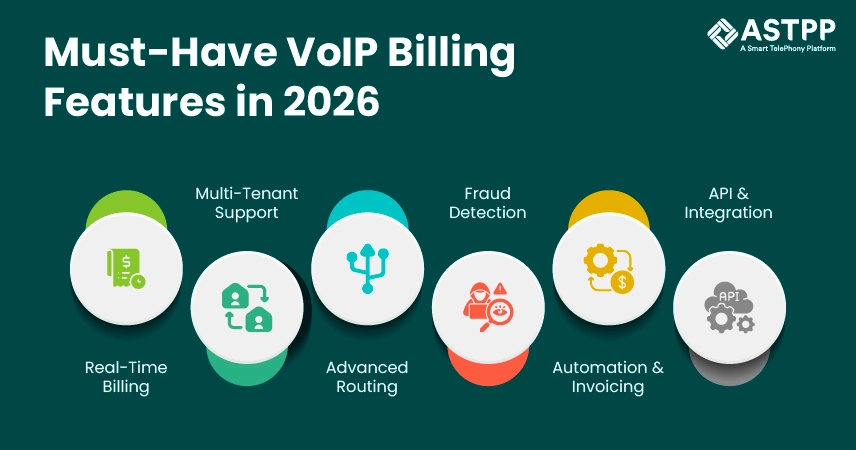
1. Real-Time Billing and Charging
This is the single most important capability in any VoIP billing platform. Real-time VoIP billing means the system rates each call leg as it occurs. For prepaid accounts especially, this is non-negotiable: without real-time charging, credit limits are meaningless and fraud exposure skyrockets.
What to look for:
- Millisecond-level CDR processing with no lag between call completion and billing.
- Online Charging System (OCS) with real-time balance enforcement for prepaid customers.
- Support for both prepaid and postpaid models within the same platform.
- Configurable rating rules per customer, rate plan, and destination.
2. Multi-Tenant and Multi-Level Reseller Support
If your business model involves serving multiple customers or if you plan to build a reseller channel, your multi-tenant billing platform needs to handle account hierarchies natively. This is not a feature to add on later; it needs to be integrated into the architecture.
What to look for:
- Native multi-tenant deployment with isolated customer data.
- Multi-level reseller billing with automatic commission calculations.
- White-label capability for resellers to brand their own portals.
- Per-tenant rate decks, billing profiles, and invoicing cycles.
Also Read: What Is Telecom Billing? How It Works and Why It Matters for Operators
3. Advanced Routing and Rating Engine
LCR (Least Cost Routing) directly determines your margin on every call. A strong VoIP billing software includes a routing engine that evaluates carrier rates in real time and selects the lowest-cost path that meets quality thresholds.
What to look for:
- LCR engine with configurable routing rules and quality-based failover.
- Flexible rate management across multiple carriers and destinations.
- Prefix-level routing with support for number portability.
- Automated rate import and comparison across carrier rate decks.
4. Fraud Detection and Security
Telecommunications fraud rose 12% in 2023, resulting in an estimated $38.95 billion in losses, with SIM box fraud, traffic pumping, and international revenue share fraud (IRSF) remaining particularly active threats. This makes it essential for your telecom billing system to include proactive fraud controls, not just reactive reporting, to protect your revenue in real time.
What to look for:
- Real-time call pattern monitoring with configurable alert thresholds.
- Automatic call blocking on suspected fraud patterns.
- SIM box detection logic built into the routing layer.
- Blacklist/whitelist management at number, carrier, and destination level.
5. Automation and Invoicing
Automation is where modern VoIP billing features pay for themselves. Operators who still process invoices manually, running exports, applying tax logic in spreadsheets, chasing payments by hand, are paying their operational costs on activities that would be handled automatically by their VoIP billing software.
What to look for:
- Configurable billing cycles (daily, weekly, monthly, custom).
- Automated tax calculation with jurisdiction-specific rules.
- Payment gateway integration (Stripe, PayPal, bank transfers).
- Dunning and automated payment retry logic.
- PDF invoice generation with custom branding.
6. API and Integration Capabilities
No VoIP billing software operates in isolation. It needs to connect to your SIP switch, your CRM, your payment processor, and potentially your customer-facing portal. A platform with limited API access or proprietary integration formats creates technical debt that gets expensive fast.
What to look for:
- REST API coverage for all core billing and routing operations.
- Native integrations with CRMs like Zoho, Salesforce, or vtiger.
- WHMCS integration for ISPs and hosting-adjacent operators.
- Webhook support for real-time event-driven workflows.
7. Scalability and Performance
Your telecom billing software needs to grow with your traffic. Platforms that hit performance ceilings at moderate call volumes or require expensive horizontal scaling to handle spikes, add unpredictable cost to your operations model.
What to look for:
- Cloud-native architecture with support for horizontal scaling.
- High Availability (HA) cluster deployment for zero-downtime operations.
- Geographic redundancy for disaster recovery.
- Proven performance benchmarks at carrier-grade call volumes.
Common Mistakes to Avoid When Choosing a VoIP Billing Software

1. Choosing Based on Price Alone
A low-cost VoIP billing solution that lacks real-time billing or LCR capability will cost you far more in revenue leakage than the licensing savings. Therefore, evaluate total cost of ownership including the cost of manual workarounds, revenue loss, and the eventual migration away from an underperforming platform.
2. Ignoring Scalability
Operators often select platforms based on current traffic volumes, then find themselves re-platforming 18 months later when growth exposes the system’s ceiling. That’s why, always evaluate a platform at 10x your current scale, not at your current volume.
3. Lack of Real-Time Billing
Batch-processed billing was acceptable in the early 2000s. In 2026, it is a liability. Without real-time VoIP billing, prepaid customers can exceed limits undetected, fraud patterns go unnoticed for hours, and reconciliation becomes a manual forensic exercise.
4. Poor Integration Support
Operators who choose platforms with limited API access end up building manual data bridges between their billing system, their switch, and their CRM. Every manual handoff is a point of failure and a drain on engineering resources.
5. No Fraud Management
Fraud prevention measures are critical for reducing costs on the platform; otherwise, one single IRSF or traffic pumping attack could create thousands of fraudulent transactions within minutes. Your billing system’s fraud management tools serve as your first line of defense.
Also Read: VoIP Fraud: Everything You Need to Know
Prepaid vs Postpaid VoIP Billing: What Should You Choose?
1. Prepaid VoIP Billing
Prepaid billing requires customers to maintain a credit balance before making calls. The VoIP billing platform deducts charges in real time through an OCS, stopping service automatically when the balance hits zero.
Advantages:
- Zero credit risk as customers pay before they consume.
- Immediate cash flow, especially for consumer and small business segments.
- Built-in fraud protection through hard balance limits.
- Reduced accounts receivable overhead.
Considerations:
- Requires a robust OCS for real-time balance enforcement.
- Top-up friction can increase customer churn in competitive markets.
- Less suitable for enterprise customers with established payment processes.
2. Postpaid VoIP Billing
Postpaid billing extends credit to customers, invoicing them at the end of a defined billing cycle. This model is common in enterprise and wholesale VoIP environments where customers have established credit relationships.
Advantages:
- Better fit for enterprise customers expecting invoice-based payment.
- Simpler day-to-day customer experience without any top-up friction.
- Easier to manage large-volume wholesale relationships.
Considerations:
- Credit exposure as customers can accumulate large balances before invoicing.
- Requires strong credit limit enforcement and dunning workflows.
- Greater accounts receivable overhead.
Hybrid Model (The Right Choice for Most Operators in 2026)
The most effective VoIP billing platform supports both prepaid and postpaid models within a single system. This lets you serve consumer and small business customers on prepaid while offering enterprise accounts postpaid terms without maintaining two separate billing platforms.
Therefore, look for a platform with a unified BSS that handles both billing models natively.
1. Open-Source vs Proprietary VoIP Billing Platforms
This debate shapes a significant portion of platform selection decisions in the ITSP and wholesale carrier market. Open-source VoIP billing platforms offer a fundamentally different value proposition from proprietary SaaS systems, and the right choice depends on your technical capabilities and business model.
2. The Case for Open-Source VoIP Billing
Open-source platforms give operators full access to the source code, the ability to customize every aspect of the system, and freedom from vendor lock-in. For operators with specific business models including unusual rate structures, custom reseller workflows, and non-standard integrations, open-source is often the only practical option.
Key Advantages:
- No vendor lock-in: You own the platform and control your roadmap.
- Full customization capability: Build the workflows as per your exact business needs.
- Lower licensing costs: Just pay for support and customization, not per-seat fees
- Transparent codebase: Audit security, compliance, and performance directly.
- Active community: For support, integrations, and feature development.
The Case for Proprietary Platforms
Proprietary platforms like PortaOne and Cerillion offer out-of-the-box functionality and vendor-managed updates. For operators who prioritize speed-to-deployment over customization flexibility, this can be appealing.
Key trade-offs:
- Licensing costs scale aggressively.
- Customization requires vendor approval and paid professional services.
- Migration away from the platform is expensive and complex.
- Feature roadmap is controlled by the vendor, not your business requirements.
When to Choose Open-Source
- You have development resources or access to a platform support partner.
- Your business model requires custom billing workflows or reseller structures.
- You are cost-conscious and want to avoid proprietary licensing escalation.
- You plan to scale significantly and need full control over performance optimization.
Also Read: ASTPP vs PortaOne: Which VoIP Billing Platform is Right for Your Business?
VoIP Billing Platform Feature Comparison Checklist
| Feature | What to Look For | Why It Matters |
| Real-Time Billing | OCS with millisecond CDR processing | Prevents revenue leakage and fraud |
| Multi-Tenant Support | Native architecture, not bolted-on | Scales without re-platforming |
| LCR Engine | Configurable routing with quality failover | Protects per-minute margins |
| Fraud Detection | Real-time alerts + auto-blocking | Limits exposure from IRSF/SIM box fraud |
| Billing Automation | Automated cycles, tax, payment, dunning | Reduces operational overhead |
| API Coverage | REST APIs for all core functions | Enables CRM/switch/portal integration |
| Scalability | HA cluster + cloud-native architecture | Handles growth without re-architecture |
| Open-Source Option | Full code access, no lock-in | Long-term flexibility and cost control |
| Deployment Flexibility | Cloud, on-premises, hybrid | Fits your infrastructure model |
Why ASTPP is the Right VoIP Billing Platform for Your Business
ASTPP is a carrier-grade, open-source VoIP billing platform that combines Class 4 and Class 5 softswitch functionality with a complete BSS including OCS, LCR engine, CDR processing, SBC, fraud detection, and multi-level reseller billing, all in a single integrated platform. It is trusted by 20,000+ telecom operators across 95+ countries.
1. Open-Source Flexibility Without the Trade-Offs
ASTPP delivers the full-code access and customization freedom of open-source, with enterprise-level support and a commercial development team behind it. You get the flexibility of an open-source VoIP billing platform without the support void of community-only projects.
2. Integrated Billing and Routing in a Single Platform
In most cases, service providers use software from one company for billing purposes and another company’s softswitch technology. ASTPP provides a solution to this problem. The billing logic and route logic both use the same data source. Therefore, any changes in rates will be incorporated automatically within the routing.
3. Built for Multi-Tenant Operations from Day One
ASTPP’s multi-tenant billing platform architecture supports unlimited customer tiers, multi-level reseller hierarchies, white-label portal deployment, and per-tenant configuration. It is not a single-tenant system retrofitted for resellers, it was built for operators who run complex account structures.
4. Cost-Effective at Carrier Grade
Operators who evaluate ASTPP against PortaOne or Cerillion consistently find that ASTPP delivers comparable carrier-grade capability at a fraction of the licensing cost. The savings are not a trade-off on functionality, they are a reflection of the open-source model applied to enterprise-grade software.
5. Flexible Deployment for Any Infrastructure Model
Deploy ASTPP on your own servers, in the cloud, or in a high-availability cluster with geographic redundancy. The platform supports all three deployment models, giving you the infrastructure flexibility to match your cost and compliance requirements.
Final Checklist Before You Choose a VoIP Billing Platform
Before signing any contract or beginning a deployment, run through this checklist against every VoIP billing solution you are evaluating:
-
-
- Does it support real-time billing?: The OCS must rate and charge calls as they happen.
- Can it scale with your business?: Test the platform’s architecture against 10x your current volume, not just your current needs.
- Does it offer full automation?: Billing cycles, invoicing, tax calculations, and payment collection should all run without manual intervention.
- Is fraud detection built in?: Real-time monitoring and automatic blocking should be part of the platform, not an add-on module.
- Does itintegratewith your tech stack?: Verify REST API coverage and confirm integrations with your SIP switch, CRM, and payment systems.
- What are the real deployment and licensing costs?: Factor in customization costs, migration effort, and the cost of vendor lock-in before comparing price tags.
- Does it support your billing model?: Confirm support for prepaid OCS, postpaid billing cycles, and hybrid models if your customer base requires them.
- Is the source code accessible?: For long-term operational control and customization, open-source access is a significant advantage over proprietary platforms.

📘Why PBXme Chose ASTPP as Its Billing Platform
See how PBXme evaluated its requirements and implemented a scalable VoIP billing solution.
Inside this Case Study:
- Platform selection insights
- Deployment and implementation journey
- Business growth outcomes
Instant access. No signup required. -
Conclusion
The right VoIP billing platform does more than process invoices. It determines how accurately your margins are protected, how efficiently your operations scale, and how much control you retain over your own business. In 2026, with VoIP competition intensifying across every market segment, operators who run on underpowered or rigid billing systems will find themselves at a structural disadvantage.
Evaluate platforms against real operational requirements, not marketing claims. Demand real-time billing, native multi-tenant support, LCR integration, fraud controls, and full API access. If you need the flexibility to build billing workflows around your business model rather than conforming to a vendor’s assumptions, an open-source VoIP billing solution with commercial support like ASTPP is the category to look at.
More than 20,000 telecom providers in 95 nations rely on ASTPP for their billing and routing systems. That is because there are some features that differentiate ASTPP from other proprietary software options: Flexibility and performance are just two of them.
Ready to Run Your Telecom Business on a Carrier-Grade Platform?


