 Introducing iCallify Built by ASTPP’s Engineering Team to Power Modern Contact Centers
Quick Summary: Effective VoIP call routing helps providers optimize traffic, control costs, improve call quality, and maximize network resources. This guide explores seven call routing strategies available in ASTPP for 2026, explaining how intelligent routing can improve operational efficiency, reliability, scalability, and overall VoIP performance.
In 2026, organizations from all sectors still depend on VoIP communication systems to ensure seamless and affordable global connectivity. With increased call volumes and complex communication needs, the role of VoIP call routing strategies has become crucial.
Be it a Class 4 Softswitch solution for carrier-level routing or a Class 5 Softswitch solution for enterprise-level communications, an optimized call routing approach can substantially improve the quality of calls, reduce latency, and decrease operational costs for any business.
In this blog, we’ll explore the top 7 VoIP call routing strategies for businesses in 2026 and how the right combination of VoIP billing solutions, DID management, and multi-tenant IP PBX systems enhances overall efficiency.
Effective Call Routing Strategies for Your Business
Before looking at the best VoIP call routing strategies, it’s vital to consider why strategic routing matters. Smart call routing powered by Class 4 and Class 5 Softswitch solutions, multi-tenant IP PBX, and DID management systems helps businesses connect calls efficiently, lower communication costs, an improved user experience.
With the support of a reliable VoIP billing system, companies can maintain full visibility and control over their call traffic setting the stage for optimal routing performance. Below are some of the most effective call routing strategies to enhance your business communication.
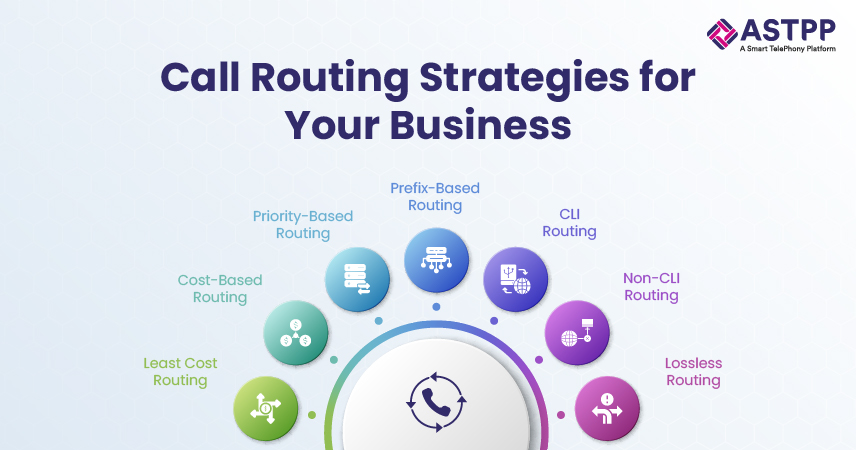
Explore multiple call routing strategies in ASTPP to manage traffic efficiently, control costs, and ensure high-quality VoIP calls.
1. Least Cost Routing (LCR) – Maximize Profitability
Least Cost Routing remains the most effective strategy for VoIP service providers and carriers. It automatically selects the most cost-efficient route for every outbound call, helping a business reduce its call expenses without compromising the quality of the calls.
When integrated into a Class 4 Softswitch solution, LCR will allow real-time rate comparison across multiple carriers and will route calls through the cheapest available provider. This, in turn, means the VoIP billing platform will support automatic rate updates and precise cost tracking
Key Benefits:
- Reduced telecom costs
- Automated route selection
- Improved profitability for VoIP providers
2. Cost-Based Routing (CBR) – Optimize for Savings
Cost-Based Routing automatically selects the lowest cost route in real-time for each outbound call based on the carrier’s rates. It is a perfect fit for VoIP providers, carriers, and resellers looking to minimize costs while maintaining quality.
How ASTPP supports cost-based routing:
ASTPP automatically compares the carrier rates, checks the prefix-based pricing, and selects the most cost-efficient route in real time.
Key Benefits
- Significant reduction in calling expenses
- Automated low-cost route selection
- Maximum profitability for VoIP service providers
3. Priority-Based Routing – Route by Business Importance
With Priority-Based Routing, calls from high-value customers or critical business lines are always processed first. This is a widely used strategy in call centers, enterprises, and managed VoIP services.
How ASTPP supports priority-based routing:
Assign routing priority levels to carriers, customers, or call types, ensuring that mission-critical calls always use the best available route.
Key Benefits
- Ensures premium service for VIP or high-value customers
- Reduces wait time for important callers
- Enhances customer satisfaction
4. Prefix-Based Routing – Precision Routing at Scale
One of the most widely used techniques in carrier-level VoIP is called Prefix-Based Routing. Calls are routed depending on the destination prefix – country code, area code, etc.
How ASTPP supports prefix-based routing:
Advanced prefix management in ASTPP allows for granular routing rules based on thousands of global dialing patterns.
Key Benefits
- Highly accurate routing decisions
- Better cost and quality control
- Ideal for global routing and termination providers
5. CLI Routing – Caller Identity–Based Routing
CLI routing routes calls according to the caller’s number. This is of great value for:
- Region-based routing
- Language-based routing
- Returning customer call handling
How ASTPP supports CLI Routing:
ASTPP detects the CLI and routes the call to dedicated teams, carriers, or regions for customized experiences.
Key Benefits
- Personalized call handling
- Better compliance with regional routing rules
- Improved customer engagement
6. Non-CLI Routing – Route Calls Without Caller ID
Non-CLI routing: It deals with calls that do not contain information about caller identity. Such calls have to be treated differently due to regulatory, security, or carrier-specific restrictions.
How ASTPP supports Non-CLI Routing:
ASTPP enables separate routing rules for Non-CLI calls to make sure that carriers and resellers remain compliant and calls do not fail.
Key Benefits
- Specialized handling for anonymous calls
- Reduces call rejection rates
- Ensures compliance with carrier and regional rules
7. Lossless Routing – Zero Revenue Leakage
Lossless routing means that no call is ever lost due to unavailable routes, rate mismatches, or prefix errors. Maximum call completion and revenue protection are guaranteed.
How ASTPP Supports Lossless Routing:
ASTPP automatically switches over to the next available carrier in case any preferred route fails, which ensures the call will always go through without financial loss.
Key Benefits
- Maximum call completion rate
- Eliminates revenue leakage
- Enhances customer satisfaction and reliability
Conclusion
As we move deeper into 2026, businesses must view VoIP call routing strategies as more than just a technical setup they are strategic enablers of performance, cost optimization, and customer satisfaction.
Whether you’re operating a Class 4/5 Softswitch, managing multiple clients using a multi-tenant IP PBX solution, or leveraging a VoIP billing platform, these five routing strategies play an important role in enabling a smarter, resilient communication ecosystem.
Build Smarter VoIP Call Routing with ASTPP : Get Started Now


