 Introducing iCallify Built by ASTPP’s Engineering Team to Power Modern Contact Centers

Quick Summary: AI-powered predictive analytics helps telecom providers forecast billing trends, identify revenue patterns, detect anomalies, and improve financial planning. By analyzing historical and real-time data, predictive models support accurate billing, reduce revenue leakage, optimize operations, and enable smarter telecom business decisions.
Often, telecom billing becomes a source of revenue leakage, delayed invoicing, and customer dissatisfaction. Certainly, fluctuating usage data, frequent pricing model updates, and complex subscriber behaviors make billing unpredictable and difficult to standardize. Moreover, traditional systems and outdated VoIP billing software solutions rely heavily on manual data interpretation. As a result, it leads to frequent oversight and delays in corrective actions. On the other hand, AI based telecom billing analytics provides measurable value.
AI powered predictive analytics in billing with other AI capabilities brings speed, precision, and data intelligence into the billing cycle. Of course, telecom providers use this approach to automate analysis, identify trends, and apply predictive logic that minimizes errors and maximizes profitability. Additionally using AI powered telecom revenue forecasting better forecasting for fraud detection, and pricing strategies are possible. Undoubtedly, AI makes billing smarter, more agile, and customer focused.
What is AI Based Telecom Billing Analytics?
It is the functionality of artificial intelligence technologies. Generally, it is incorporated into automated predictive billing systems or similar to streamline and optimize billing processes. It encompasses the use of machine learning algorithms to analyze huge data sets, deduce patterns, and make decisions automatically without human interference.
Understanding Predictive Analytics in Billing and Key Elements of Automated Predictive Billing Systems
Predictive analytics in billing involves using statistical techniques along with AI and ML algorithms. Moreover, FreeSWITCH development company developing this solution also implements AI powered telecom revenue forecasting in the system. As a result, it forecasts future billing events and trends.
This approach allows telecom companies to anticipate customer behavior, detect potential issues before they arise, and make data-driven decisions.
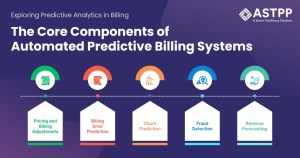
Key elements of automated predictive billing systems include:
- Pricing and Billing Adjustments: Recommending optimal pricing strategies based on customer usage patterns and market trends.
- Billing Error Prediction: Detecting and correcting billing errors before they impact customers.
- Churn Prediction: Identifying customers who are likely to discontinue services, allowing for targeted retention strategies. US telecom companies have seen a 25–40% boost in churn prediction accuracy by leveraging AI, enabling them to take proactive steps to retain their most valuable customers. (Source)
- Fraud Detection: Recognizing unusual billing patterns that may indicate fraudulent activities.
- Revenue Forecasting: Estimating future revenue based on current and historical data, aiding in financial planning.
Leveraging AI for Predictive Analytics in Telecom Billing
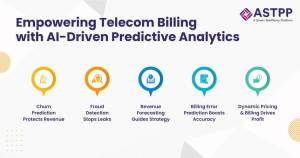
Undoubtedly, predictive analytics in billing is reshaping how telecom providers manage billing systems. Instead of relying on static historical data, they now use AI based telecom billing analytics to forecast risks, identify irregularities, and maximize revenue potential.
With real-time signals and machine learning, these systems help providers respond faster, act smarter, and improve both performance and customer experience. Let’s explore how predictive capabilities in automated predictive billing systems bring lasting advantages.
Churn Prediction That Keeps Revenue Intact
Customer loss often starts with small behavior changes. Moreover, reduced usage, delayed payments, or rising support tickets usually come before cancellation. However, many providers miss these signals until it’s too late.
Using AI based telecom billing analytics, businesses can track patterns linked to churn. When the system flags an account, the team can intervene with targeted support or personalized offers. As a result, retention improves, and long term revenue stays protected.
Fraud Detection That Prevents Revenue Leakage
Telecom fraud costs companies billions each year. Certainly, from SIM swaps to fake call records, billing fraud takes many forms. Manual reviews often catch it too late, after the damage is done.
Predict Revenue Leaks Before They Happen!
AI helps by monitoring billing data continuously with predictive analytics in billing. Moreover, it flags any anomalies that don’t match regular customer behavior. This gives providers the time to act quickly, reduce loss, and maintain user trust before issues spiral out of control.
Revenue Forecasting for Strategic Planning
Predicting revenue allows operators to plan with confidence. However, traditional models often rely on seasonal trends or fixed patterns that ignore evolving usage behavior. In contrast, AI based telecom billing analytics processes live data from every customer, service, and location. This produces highly accurate forecasts. As a result, leadership can make more informed budgeting, marketing, and expansion decisions.
Billing Error Prediction to Improve Accuracy
Even small billing errors can cost customer trust and lead to disputes. Moreover, annual checks help, but they often come after the bill is sent. That delays resolution and damages relationships.
With AI powered telecom revenue forecasting, the billing engine spots inconsistencies during invoice generation. If a charge doesn’t match past behavior or expected usage, it flags it immediately. Undoubtedly. This allows the team to fix issues before customers notice them. Moreover, it keeps satisfaction high and complaints low.
Pricing and Billing Adjustments for Profitability
Markets shift. So do customer needs. Static pricing models fail to keep up, leading to missed revenue opportunities or loss of competitive edge.
AI-powered billing systems with AI powered telecom revenue forecasting monitor customer usage patterns, spending trends, and service preferences in real time. Based on this insight, the software can recommend pricing changes or create dynamic plans tailored to different segments. This keeps offers profitable and relevant while improving user satisfaction at the same time.
AI Driven Telecom Revenue Predictions
With AI powered telecom revenue forecasting, businesses can steer away from guesswork and create more intelligent revenue models. These automated predictive billing systems look over decades of billing information, patterns of customer behavior, usage trends, and seasonal fluctuations. As a result, this data helps to forecast future revenue streams more accurately than human methods ever could.
Consequently, decision-makers receive an up-to-date financial roadmap with AI based telecom billing analytics. From budgeting for infrastructure improvements to growing into new areas of service, AI-supported forecasts minimize risk. They identify slow-paying territories, churn-prone plans, and underperforming services. This enables finance teams to optimize strategy in advance rather than responding to revenue shortfall after the fact. Further, AI powered telecom revenue forecasting based on telecom billing analytics guarantees companies are putting resources where demand is real.
Using predictive analytics in billing, organizations have the visibility necessary to refine product propositions. Moreover, they can also optimize promotional programs and even anticipate regulatory cost shifts well ahead of time.
Concluding Notes
In conclusion, the integration of AI based telecom billing analytics marks a significant advancement in the telecommunications industry. Automating billing processes and leveraging predictive analytics, telecom companies help in enhancing operational efficiency, reducing errors, and improving customer satisfaction. As the industry continues to evolve, embracing predictive analytics in billing with other AI technologies becomes crucial for staying competitive and meeting the growing demands of customers.
We develop powerful automated predictive billing systems tailored to client requirements. To explore how our solutions can revolutionize your billing operations through AI based telecom billing analytics, contact us now.


