 Introducing iCallify Built by ASTPP’s Engineering Team to Power Modern Contact Centers
Quick Summary: AI-powered telecom operations improve efficiency by automating monitoring, analytics, routing, billing, and routine workflows. These capabilities help telecom providers reduce operational costs, identify issues faster, improve service reliability, enhance decision-making, and scale communication services while delivering better customer experiences.
Telecom service providers continue to experience avoidable disruptions. For example, unexpected signal losses, delayed fault detection, and under-used network resources. Certainly, these inefficiencies impact uptime, degrade service quality, and increase operational expenses. Therefore, without a reliable system for analyzing usage patterns, forecasting faults, or load balancing, teams tend to respond to issues rather than prevent them. Certainly, AI powered telecom operations efficiency empowers VoIP providers and other telecom operators because they make telecom systems predictive from being reactive.
AI boosts telecom operational efficiency with its powerful algorithms, which further allow the providers to operate massive-scale operations. Additionally, AI optimizes telecom cost management using intelligent automation, real time analytics, and network behavior modeling. Unquestionably, it automates traffic management, customer interactions, and fault remediation.
Consequently, operators minimize manual labor, eliminate unnecessary costs, and provide quality consistently throughout their service radius. Furthermore, this transition is not something in the future. But it is happening now and changing the way top telecom providers operate on a scale.
In this blog post, we will cover more details about AI powered telecom operations efficiency along with real benefits and hypes that are here to fade away.
What is AI Powered Telecom Operations Efficiency?
According to the top VoIP development companies, it refers to utilization of artificial intelligence technologies, specifically to optimize various aspects of telecom operations. Certainly, this includes several jobs such as:
- Automating routine tasks
- Predicting and preventing network failures
- Enhancing customer service through virtual assistants and
- Managing network traffic intelligently.
Undoubtedly, telecom operators can achieve higher efficiency, reduced operational costs, and improved service quality when AI boosts telecom operational efficiency with the right tools. According to a report by Magnet ABA, AI is driving operational improvements across industries, with 54% of executives noticing a significant boost in productivity due to AI integration. (Source)
Key Elements for AI in Telecom
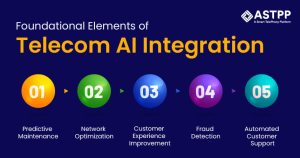
Deploying AI in telecommunications has a number of key elements that you can look for while aiming to use this technology to achieve AI powered telecom operations efficiency.
- Predictive Maintenance: AI algorithms scan data to forecast equipment breakdowns ahead of time, cutting downtime and maintenance expenditures.
- Network Optimization: AI assists real-time management of network resources, delivering optimal performance even at times of peak usage.
- Customer Experience Improvement: Using AI analytics, telcos can tailor services and nimbly solve customer problems.
- Fraud Detection: AI technologies can detect anomalies and possible fraud, strengthening security.
- Automated Customer Support: AI chatbots and virtual assistants ensure 24/7 customer support, raising response time and customer satisfaction.
AI in Telecom: Hype with Benefits

Often, Artificial Intelligence is wrapped in buzzwords, especially across large-scale industries like telecom. However, when we move past the surface-level hype, real and measurable improvements begin to show. Many telecom operators are now actively shifting from reactive processes to predictive and self-optimizing networks.
Let’s explore seven practical ways AI powered telecom operations efficiency brings measurable value to telecom providers.
1. Enhanced Network Reliability Starts with Prediction
Undoubtedly, network outages can severely impact customer retention and operational continuity. Traditionally, telecom operators relied on manual monitoring and post-incident troubleshooting. But now, with AI-driven predictive analytics, anomalies are detected before failures occur.
Machine learning algorithms constantly evaluate network traffic, node behaviors, and device statuses. As a result, if irregular patterns arise, the system triggers alerts or resolves them autonomously.
Transform Your Telecom Ops with AI.
Certainly, this proactive maintenance reduces unplanned downtimes. Additionally, it increases service reliability and reassures customers who depend on uninterrupted connectivity. As a result, AI optimizes telecom cost management to the extent that companies can start enjoying reliability and cost benefits altogether.
2. Cutting Operational Costs through Automation and Intelligence
Unquestionably, AI boosts telecom operational efficiency with its power to automate. It automates provisioning, ticket routing, performance checks, and diagnostics, freeing human experts for complex responsibilities. Moreover, this automation reduces the need for extensive support staff and limits human error. In addition to that, AI helps optimize power usage and resource deployment based on real-time demand.
All in all, it lessens costs tied to labor, energy, and SLA violations. Hence, AI powered telecom operations efficiency directly supports profitability without compromising on service delivery.
3. Driving Revenue with Personalized Services
With attention to the fact, blanket marketing no longer works. Customers expect relevance, and AI delivers that with AI powered VoIP operations efficiency. Using behavioral patterns, call history, and usage data, AI helps telecoms create hyper-personalized offers.
For instance, a high-data user might receive a discount on an unlimited plan before they consider switching providers. Similarly, prepaid users can get timely top-up prompts or content bundles based on consumption history.
These targeted campaigns increase upselling and cross-selling opportunities while also fostering customer loyalty. Thus, AI boosts telecom operational efficiency and drives bottom-line growth simultaneously.
4. Proactive Threat Detection for Better Security
As digital communications expand, so do the threats. Phishing, spoofing, and DDoS attacks cost telecom firms billions annually. AI introduces a stronger, faster defense system while AI optimizes telecom cost management with security features.
With pattern recognition and anomaly detection, AI security tools flag suspicious activities in real-time. They isolate compromised endpoints, block malicious IPs, and alert teams instantly. Often, before the attack unfolds fully.
5. Smarter Network Management at Scale
Through autonomous network orchestration, AI manages updates, balances loads, and corrects minor failures before they escalate. Moreover, AI also adapts to new devices, applications, and protocols without constant manual intervention for telcos with AI powered telecom operations efficiency.
This efficiency reduces deployment time, increases service agility, and enhances the scalability of telecom networks.
Concluding Notes
To sum up, AI powered telecom operations efficiency into core processes helps eliminate bottlenecks and introduces agility. Of course, it automates customer service, detects network failures, or supports predictive decision-making, AI delivers tangible improvements across all departments. Certainly, it doesn’t just solve existing inefficiencies. However, it builds a system that grows smarter with every interaction and assures benefit of AI optimizes telecom cost management.
AI boosts telecom operational efficiency for telecom providers to cut waste, boost up time, and serve users with speed and precision. Undoubtedly, it is already redefining how smart networks, customer teams, and backend systems operate.
We help businesses get advantage of AI powered telecom operations efficiency at fullest. Contact us to find out how we can make it happen for your telecom business.


