 Introducing iCallify Built by ASTPP’s Engineering Team to Power Modern Contact Centers

Quick Summary: Multi-3CX deployments can create hidden costs related to licensing, infrastructure, administration, maintenance, and scalability. This guide explores these challenges for VoIP providers and explains how understanding operational expenses can help businesses plan better, control costs, improve efficiency, and scale sustainably.
From the outer surface, running multiple 3CX servers seemed possible in the first place. However, one of our clients is increasingly facing problems with it. As a result, the bigger the customer base, the bigger the operational costs became, the bigger the administrative workload, and the bigger the scalability issues became. Isn’t it too much to deal with when you are building a growing business? Certainly, the only thing a business owner and VoIP Providers needs is scalable technology and infrastructure.
They were running multiple independent 3CX installations, with each one for a separate customer. On the surface, it worked, but the arrangement created steadily increasing costs, fragmented operations, and limited growth from a long-term perspective.
To alleviate these problems, the client transitioned to ASTPP Open Source VoIP Billing Solution, a full VoIP featured, carrier-grade VoIP billing and PBX solution for VoIP Providers. Certainly, ASTPP aims to offer efficiency, scale, and integrated automation.
The Problem with a Multi-3CX Setup
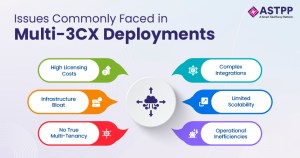
Licensing Costs That Escalate Quickly
3CX utilizes a simultaneous call and extension limit-based tariff approach. As more clients were being onboarded, the client was confronted with a hugely increased recurrent cost, thereby reducing profitability.
Infrastructure Bloat and Maintenance Overhead
Each lead would have an instance of 3CX; therefore, more servers, more infrastructure to maintain, and more maintenance demands. This was really not an efficient model to go with and a big waste of resources.
Lack of True Multi-Tenancy
3CX is not multi-tenant by design; hence, all deployments were siloed, limiting centralized visibility and increasing administrative overhead.
Complex Integration Workarounds
Integration with CRM, billing software, and other third-party tools require custom integrations, further delaying deployment and increasing support complexity. Moreover, 3cx does not offer any custom development as per your business requirements.
Poor Scalability for Growing Demand
With an ongoing need for scaling the services, new 3CX instances had to be added, each requiring a separate setup and monitoring. The architecture, so arranged, could not support the expansion of service quickly.
Operational Inefficiencies
Provisioning new users, changing the configurations, and resolving support issues were all very repetitive and time-consuming, thereby resulting in decreased throughput for operations.
What Made Multi-3CX Unworkable Long-Term
- A higher licensing fee for every client
- Increased execution and infrastructure costs for using servers
- Lack of central multitenant control
- Delayed integration to business tools
- Limitations on growth when clients increase
- Support overheads weigh heavily, and supplying services inconsistently
Why ASTPP Made Sense
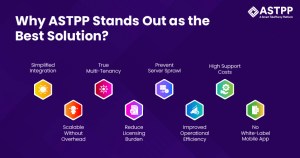
The client required a system to centralize the operations and reduce the bottom line, thereby supporting actual multi-tenancy and scaling with demand.
Solving the Licensing Burden
In contrast to 3CX (what people are saying about the 3CX), which imposes limits and fee restrictions on license fees based on simultaneous calls or number of extensions, ASTPP removes any user-based or call-based licensing structure. Instead, it puts forth transparent usage-based or fixed-rate tiers that empower providers to scale without the downside of a financial penalty. Undoubtedly, this predictability in pricing gave the client some financial clarity with operational independence to onboard another batch of customers without having to recalculate budget allocations or redesign licensing thresholds with every quarter. Certainly, the ability of ASTPP to flexibly bill awards an advantage to services that generate variable traffic or have evolving customer requirements.
Eliminating Server Sprawl
ASTPP is built with service provider scalability in mind. Due to its native multi-tenancy, the client could completely do away with many standalone 3CX instances by instating a single, central deployment. Certainly, this takes away the incongruences of managing multiple physical or virtual servers. In contrast to 3CX, where one instance is a must for one customer, ASTPP, with its consolidated environment that is highly available, truly cuts down maintenance overhead, system redundancies, and deployment time.
Enabling Real Multi-Tenancy
True multi-tenancy is an emphasis where ASTPP stands a chance against 3CX at a very basic architectural level. Unquestionably, 3CX lacks a native multi-tenant framework and requires independent deployments for each tenant. Conversely, ASTPP delivers each client with a logically isolated service environment under one software instance. This represents independent access control, billing rules, security settings, and resource assignments. Administrators retain granular control over each tenant’s operation without threatening data privacy or system performance. For the client, this meant centralized management with full capability of operational autonomy for tenants that 3CX could not provide outside the box.
Streamlining Integration
With 3CX, third-party software integrations such as CRMs, ERPs, or external billing engines were anathema to comity, which is limited in support and needs heavy modifications. Conversely, ASTPP comes with exhaustive REST APIs and built-in modules, which allow smooth integration with business platforms most commonly used. Moreover, integrating existing client CRM and accounting tools with ASTPP was transparent and required minimal development effort. Such a simple measure shortened severely the implementation time and allowed quick go-to-market timing for new service offerings.
Scaling Without the Overhead
Previously, for scaling a solution with 3CX, it was mandatory to create new instances. Moreover, each of these instances requires separate configuration, resource allocation, and support. On the other hand, ASTPP eliminates this complexity. Now, within the same system architecture, the client gets to provision new tenants without creating duplicate server infrastructure. As a result, ASTPP’s elastic scalability extends effortlessly to accommodate burgeoning subscriber bases without impacting performance, maintaining a seamless experience for all. Such capability serves belly providers who engage in rapid geographic or customer expansions.
Boosting Operational Efficiency
ASTPP provides all key VoIP management functions under one interface: provisioning, monitoring, billing, and reports. As a result, operations are streamlined as 3CX’s administration is fragmented across different instances with no automated operation. Interestingly, ASTPP offers elements such as automated account provisioning, bulk configuration tools, and real-time monitoring dashboards. As a result, the client’s technical team is able to reduce manual intervention, shorten response times, and ensure that the quality of service from all customer accounts is consistent. Consequently, the support team’s efficiency increased; there were fewer support tickets generated, and rapid customer activation.
High Cost of Support
The 3CX support system works on a per-ticket basis, which soon becomes a nightmare for those suppliers who need constant help. In addition to the licensing fees that are based on number of users and simultaneous calls, every single technical question becomes a costly one, thus turning support into a costly and unpredictable service that is always responding to rather than preventing problems. On top of this, 3CX does not provide any of the live support channels, such as chat or phone, which are essential for telecommunications companies that need to resolve problems instantly.
No White Label Mobile App
The lack of a white label mobile application for providers is yet another significant downside of the 3CX system. This not only means that service providers will not be able to provide consistent branding across all platforms but also that they will not be able to give personalized experience to the end-users, especially resellers or partners who have mobile extensions as part of their services.
Summary: What ASTPP Solved
- Outdated licensing was replaced with transparent and scalable pricing.
- All customer management was consolidated under one system.
- Enabled secure multi-tenant isolated architecture.
- Simplified workflows for CRM and billing integration.
- Provided instant tenant provisioning without server sprawl.
- Reduced technical and operational friction.
- Technical support is unavailable on a real-time or phone basis
- No white-label mobile application for customer-facing branding
ASTPP Delivered More Than Just Cost Savings

Decreased Operational Costs
By merging systems and automating mundane tasks, the client managed to significantly cut the costs of infrastructure and human resources.
Integrated Real-Time Billing
ASTPP’s native call billing engine provides real-time billing, credit limit enforcement, usage reports, and automated account management.
Scalable and Future-Ready Architecture
The architecture ability of ASTPP supports very high-volume levels of service delivery with almost zero latency and negligible resources. As a result, the business can scale up easily, on request, as needed.
Faster Troubleshooting and Onboarding
Using centralized monitoring and diagnostic tools would enable the technical team to identify and fix service issues quickly.
Advanced VoIP Features
Call routing, Call Rating, IVRs, voicemail, conferencing, and usage analytics were integrated directly into the system, minimizing reliance on third parties.
Security and Access Control Improvements
Firewall policy and fraud detection, anti-fraud, and role-based permissions were all undertaken centrally to introduce a much better risk mitigation framework.
Partner-Ready Customization
ASTPP enabled full white-labeling, custom branding, and reseller setups, thus allowing the client to expedite the roll-out of partner programs.
Reliable Support
ASTPP does not charge customers for each support ticket and does not let cost considerations hamper vital support functions. The provision of real-time chat, voice-based support, and unlimited ticket-based assistance are all included in the commitment of the company. The client considered this model much more responsive and scalable compared to that of 3CX, which was paying per ticket.
White Label Mobile Application
ASTPP provides a mobile application that supports complete white labeling. Moreover, businesses can fully customize the app. Moreover, it can be used by providers to give branded communication experiences to their customers on both iOS and Android. This was a considerable improvement over 3CX’s fixed-branded app. As a result, it allows the client to create a unified visual identity across channels, boost user engagement, and facilitate white-label partnerships with resellers.
Benefits at a Glance:
- Reduced infrastructure and management costs
- Integrated billing and automation capabilities
- Simpler provisioning and monitoring
- VoIP features already built-in; no need for add-ons
- Increased client onboarding speed
- Uniform security policies across tenants
- White-labeling and partner support capabilities
- Delivered unlimited chat, call, and ticket-based support
- Enabled branded mobile applications for client-facing flexibility
The Outcome: Positioned for Scalable Growth
- After migrating to ASTPP, the client realized the benefits in concrete terms:
- Reduced total cost of ownership by an impressive 50%
- Abolishing dependence on disparate, standalone PBX instances
- Faster time for provisioning new customers
- Better SLA conformance and service consistency
- Exceptionally clear alignment of operational infrastructure with long-term business goals
Final Thoughts: A Smart Move for Forward-Thinking Service Providers
In conclusion, this case illustrates the inability of a fragmented 3CX. Certainly, with these complexities of 3CX, no business can ever accommodate growth. Undoubtedly, service providers relying on isolated systems will always incur increasing costs. As a result, they should never expect time savings and seamless integration without any hassle.
Indeed, ASTPP by design addresses all issues. It creates a consolidated and high-performance platform in place of an outdated infrastructure. Therefore, from VoIP billing and security to scaling and voice customization, a business can seamlessly construct any flow and secure growth and scalability.
ASTPP offers a tried and tested future-proof way to consolidate platforms, cut down costs, and provide agile services.
Get in touch now to make the switch to ASTPP and simplify your operations while expediting your business growth.


