 ASTPP v7.3 Launch Webinar – Join Us on Sept 30, 2026
Quick Summary: VoIP billing software helps ITSPs monetize voice services through automated rating, flexible pricing, real-time billing, and usage tracking. It supports multiple revenue models, improves operational efficiency, controls costs, and enables scalable, profitable voice service management.
Most ITSPs don’t lose money because they sell too little voice traffic. They lose money when their VoIP billing software can’t keep up with the way their business works including changing rates, reseller margins, free-minute bundles, and shifting carrier routes. When billing can’t track these changes in real time, calls still go through, but revenue is lost.
That’s why VoIP billing software is different from a basic invoicing tool. ITSPs bill millions of individual call events, each with its own rate, duration, destination, and account rules. If billing is inaccurate at scale, the losses don’t appear as one large amount. Instead, small revenue leaks happen every day and can easily go unnoticed.
What a VoIP Billing Platform for Telecom Operators Actually Needs to Do
A VoIP billing platform for telecom operators is more than a tool for creating invoices. It needs to manage everything from the moment a call connects to when the CDR is generated. This includes checking prepaid balances, applying rate groups, deducting free minutes, and applying fraud rules before the call is billed.
For an ITSP, the platform needs to handle:
- Prepaid and postpaid accounts running at the same time
- Multiple rate groups based on prefix, time of day, or carrier
- Reseller and sub-reseller markups while keeping margins hidden from customers
- High CDR volumes that scale with call traffic
- Real-time billing and balance management
- Fraud detection and prevention during the billing process
Missing any of these can lead to billing errors, revenue leakage, and customer disputes. That’s the key difference between a VoIP billing platform for telecom operators built for telecom workloads and a generic billing system with VoIP features added later.
Where ITSPs Quietly Lose Margin
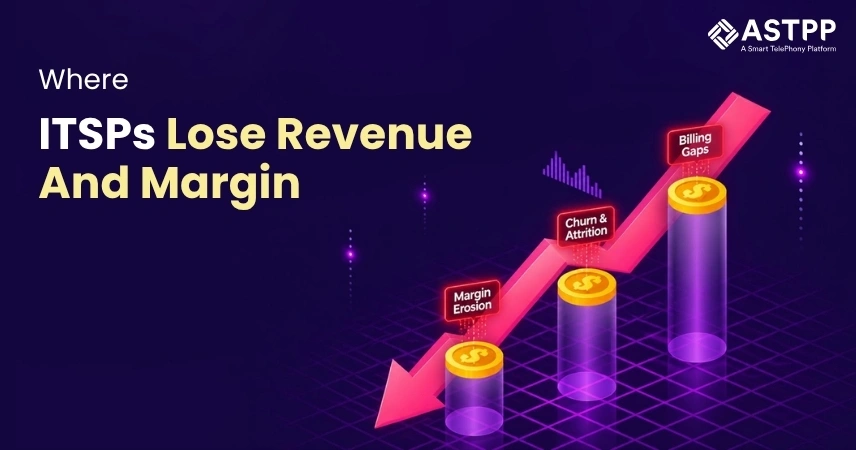
The problems usually don’t come from one major failure. They come from small billing errors that repeat and add up over time:
- Revenue leakage from calls that were routed but not billed correctly, especially with free-minute packages or mid-call rate changes
- Routing decisions based only on cost, without checking whether the cheaper carrier is completing calls
- Manual rate updates across multiple resellers, where one missed update can lead to underbilling for weeks
- Fraud detection delays that allow fraudulent traffic to continue until the billing cycle ends
These aren’t just technical problems. They’re billing accuracy problems that a properly built VoIP billing software platform should help prevent before the CDR is finalized.
According to Grand View Research, the global mobile VoIP market was valued at USD 44.9 billion in 2023 and is expected to grow from USD 64.7 billion in 2026 to USD 104.9 billion by 2030, representing a 12.9% CAGR from 2024 to 2030. As VoIP traffic continues to grow, these small issues can have a bigger financial impact. More traffic means every unbilled minute, incorrect rate, or missed fraud event can multiply across thousands or millions of calls.
What a Real-Time VoIP Billing System Is Built From

A real-time VoIP billing system helps ITSPs identify and prevent billing issues while a call is still active instead of discovering them at the end of the month. It combines several key capabilities:
- Nibble billing deducts balance during an active call instead of waiting until hang-up, helping prevent prepaid accounts from going into negative balance.
- Least Cost Routing (LCR) considers both carrier cost and call quality, including ASR and ACD, so the cheapest route doesn’t come at the cost of poor call completion.
- Multi-tenant billing architecture allows resellers, sub-resellers, and customers to be managed and billed within one system.
- Automated CDR processing compares actual and billed call duration and helps identify free-minute, forwarded-call, and other billing discrepancies before invoicing.
- Fraud and rate-change alerts help identify unusual traffic, billing changes, and potential fraud while they are happening.
Open-source flexibility can also be valuable here. A closed billing platform may force ITSPs to adapt their business processes to the system. A customizable platform allows billing rules to be configured around the ITSP’s business model.
Why Platform Choice Matters More for a VoIP Platform for ITSPs
A VoIP platform for ITSPs needs to do more than manage calls. It also handles billing, reseller management, routing, and fraud protection. When these systems run on live traffic, even small mistakes can lead to lost revenue.
ASTPP is built around the needs of ITSPs, with features such as:
- Real-time billing with nibble billing and accurate free-minute tracking through the CDR pipeline
- Multi-level reseller billing for distributors, resellers, and commission-based partners
- LCR with quality-based routing using ASR to balance carrier cost and call completion
- Open-source, customizable architecture for rate logic, tax rules, reseller markups, and other business requirements
- Carrier-grade deployment options, including cloud, on-premises, and HA cluster deployments
Compared with enterprise platforms like PortaOne or Cerillion, or developer-focused open-source tools that require significant custom development, ASTPP offers ITSPs a combination of carrier-grade billing, customization, and flexibility without the complexity and cost of a large enterprise implementation.
What This Looks Like Once It’s Running
Here are a few real-world examples of how this works:
- A wholesale ITSP manages LCR across multiple carrier trunks, with rates adjusted as ASR changes throughout the day.
- A retail ITSP offers prepaid calling plans, while nibble billing prevents customer balances from going negative during active calls.
- A reseller network uses different markups at each level, with invoices automatically reflecting the correct rates without manual reconciliation.
- An ITSP migrates from a legacy billing platform and gains better visibility into per-destination costs, revenue, and margins.
In each case, the benefit isn’t simply another feature. It’s accurate billing, better margin visibility, and greater control over the business.
Closing Thoughts
Monetizing voice services isn’t just about selling more minutes. It’s about billing every minute accurately and in real time, so revenue doesn’t slip through the cracks. That’s the core purpose of VoIP billing software and why choosing the right platform matters.
A VoIP billing platform for telecom operators with real-time processing, multi-tenant billing, and flexible customization helps ITSPs turn call traffic into measurable revenue and protect their margins.


