 Introducing iCallify Built by ASTPP’s Engineering Team to Power Modern Contact Centers
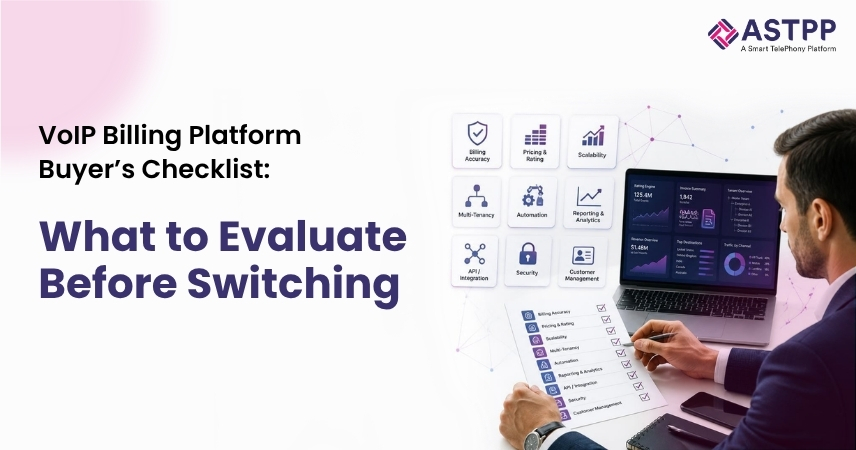
Quick Summary: This buyer’s checklist helps telecom operators evaluate VoIP billing platforms based on scalability, automation, integrations, security, pricing, reporting, and support. Discover the essential features and considerations needed to choose a reliable billing solution and ensure a smooth transition.
Switching your VoIP billing platform is not a decision most telecom operators make often, so it deserves more than a simple feature comparison. If you’re a wholesale carrier, ITSP, or SIP trunking provider outgrowing your current system, the real cost of a wrong choice can appear months later in unbilled minutes, growing support issues, or reseller features the platform can’t handle.
This checklist covers what really matters when choosing a new VoIP billing platform, so your investment supports your growth instead of becoming another migration you regret.
Why Operators Reconsider Their Billing Platform in the First Place
Most switching decisions don’t start with “let’s shop for new software.” They start with a problem. A reseller finds that their commission report doesn’t match their numbers. A finance lead discovers that free-minute customers are still being billed. A rate change takes days because no one remembers how the old rate groups work.
Common reasons include:
- Revenue leakage that appears during reconciliation but can’t be traced in the CDRs
- A telecom billing system that can’t support new products such as SMS, DID bundles, or auto dialer campaigns without custom development
- Licensing costs that grow faster than the business
- A rigid multi-tenant structure that doesn’t support your reseller model
- Routing and rating logic that depends on someone’s knowledge instead of being built into the platform
These aren’t reasons to switch immediately. They’re reasons to create a proper checklist and evaluate your options carefully. That’s what the rest of this guide covers.
Core Evaluation Criteria for a VoIP Billing Platform
Before booking product demos, separate your must-haves from your nice-to-haves. Vendors can make every feature sound essential. Your job is to focus on what your business actually needs.
1. Billing Accuracy and Real-Time Rating
This is one area where “close enough” isn’t good enough. Ask vendors to show you live how the platform handles:
- Mid-call balance deduction, not just end-of-call billing
- Free-minute packages without double-billing
- Prorated charges when a product starts or ends mid-cycle
- Surge or time-based rates applied automatically
If a vendor can’t demonstrate these features live, that’s a warning sign.
2. Least Cost Routing (LCR) and Margin Control
Routing decisions affect your margins call by call. A good platform should support:
- Priority, percentage, and quality-based (ASR) routing
- Rate simulation before changes go live
- Carrier and rate group management without developer involvement
If your main issue is low margins on wholesale traffic, this should be a top priority.
3. Multi-Tenant and Reseller Architecture
If resellers are part of your business model, check whether the platform supports:
- Independent rate groups and markups for each reseller
- Automatic commission tracking and reconciliation
- N-level visibility across sub-resellers
A platform built around a single-tenant PBX can struggle with these requirements as you grow.
4. Scalability of the Underlying Architecture
This is where you see the difference between scalable telecom billing software and a platform that only works at your current size. Ask vendors:
- What’s the largest CDR volume handled by a live customer?
- How does the system perform in an HA (high-availability) cluster?
- How does migration work for hundreds of thousands of accounts without data loss?
If a vendor can’t provide real examples, it may not have been tested at your scale.
5. Deployment Flexibility
Some operators need on-premises deployment for regulatory requirements, geographic redundancy, or cost control. A carrier-grade VoIP billing platform should offer options such as:
- Cloud-native deployment
- On-premises deployment
- Hybrid environments
- Geographic redundancy for disaster recovery
6. Compliance, Fraud Detection, and Security
Don’t wait for a security problem to think about these requirements. Check for:
- KYC workflows for DID purchases and number assignments
- IP-level security controls with audit logging
- VoIP-specific fraud detection
- Allow/deny lists and DNC (Do Not Call) management
7. Customization Without Vendor Dependency
This is one of the most overlooked criteria until a business hits a limitation. Ask:
- Can we modify workflows ourselves, or does every change require a vendor ticket?
- Is there open-source or source-level access, or is the platform a black box?
- What’s the actual turnaround time for custom feature requests?
A rigid telecom billing system can lock you into a vendor’s roadmap, even when it no longer matches your business needs.
Red Flags to Watch for During Evaluation
A few warning signs can reveal a poor fit before you sign a contract:
- Demos that only show the happy path and avoid edge cases such as failed payments or mid-cycle changes
- Vague answers about API access or integration capabilities
- Pricing that increases significantly when you ask about multi-tenant or reseller features
- No clear migration plan, or a plan that hasn’t been tested with a dataset your size
- Support that is only available in one time zone when your operations are global
If a vendor can’t give clear answers during the evaluation, it’s worth asking why before moving forward.
How ASTPP Approaches This Checklist

A carrier-grade VoIP billing platform should be able to address every item on this checklist clearly. ASTPP combines Class 4/5 softswitch capabilities with an integrated BSS and Online Charging System, bringing billing and routing into one platform instead of relying on separate tools.
For operators comparing platforms, key capabilities include:
- Real-time billing with accurate free-minute handling and prorated charges
- LCR with priority, percentage, and quality-based routing, plus a rate simulator for testing changes before they go live
- Native multi-tenant and multi-level reseller billing with commission tracking
- Cloud, on-premises, and HA cluster deployment options with geographic redundancy
- An open, customizable architecture that reduces dependence on vendor support for every change
- KYC, fraud detection, and IP security built into the platform
Migration is also an important part of the decision. A recent on-site migration for a long-standing operator moved a 4-server HA cluster with 95 million CDRs and more than 600,000 customer accounts with zero data loss in one hour and 38 minutes, ahead of the scheduled window.
That’s the kind of real-world evidence a migration plan should provide and not just a promise of “seamless migration.”
Final Checklist Before You Sign

Before committing to any VoIP billing platform, run through this shortlist one more time:
- Has the vendor demonstrated billing accuracy on edge cases, live?
- Does the routing engine support the strategies your traffic needs?
- Is the reseller and multi-tenant model a true fit, not a workaround?
- Has scalability been proven with a dataset close to your own size?
- Do you have deployment flexibility, or are you locked into one model?
- Are compliance and fraud tools built in, not added later?
- Can you customize the platform without waiting on the vendor’s schedule?
- Is there a documented and tested migration process?
If a platform can answer all eight clearly and honestly, you’ve likely found a scalable telecom billing software partner, not just another vendor you’ll need to replace in two years.


