 Introducing iCallify Built by ASTPP’s Engineering Team to Power Modern Contact Centers

Quick Summary: Effective VoIP call routing helps businesses improve call quality, control costs, balance traffic, and deliver reliable communication. This guide explores key routing techniques that help VoIP providers optimize call paths, improve operational efficiency, enhance customer experiences, and support sustainable business growth.
Every call your VoIP network carries is a real-time business decision. If a call is routed through the wrong carrier, fails over too late, or relies on a static routing table, it can directly impact both call quality and profit margins. For telecom operators, ITSPs, and wholesale VoIP carriers, VoIP call routing is not just an infrastructure detail, it is a core driver of profitability and service reliability.
According to a report, the global VoIP services market is projected to reach approximately US$160.8 billion in 2025 and is expected to grow to around US$340.2 billion by 2032, expanding at a compound annual growth rate (CAGR) of 11.3% over the forecast period (2025–2032). In this environment, operators with optimized routing strategies gain a clear cost and performance advantage over those using static or legacy configurations.
This article explains the main VoIP call routing techniques used by operators today, the business logic behind each approach, and how ASTPP’s carrier-grade routing engine unifies these strategies into a single platform.
What Is VoIP Call Routing and Why Does It Matter for Operators?

VoIP call routing is the process where a softswitch or routing engine selects the optimal path for each call from origin to destination. Unlike traditional PSTN routing, VoIP routing is dynamic and evaluates multiple factors such as cost, quality, capacity, and compliance before every call attempt in real time.
Advanced VoIP billing software solutions often include intelligent routing capabilities to help operators balance quality, profitability, and network performance.
For a wholesale carrier handling large volumes of traffic every day, the difference between a well-optimized routing table and a generic one can lead to significant savings in termination costs. For a retail ITSP, inefficient routing quickly results in poor call quality and higher customer churn. At scale, the routing layer becomes a key determinant of both margin and service reliability.
Operators rely on routing to achieve three primary objectives:
- Cost optimisation: Directing traffic to the lowest-cost carrier that still meets quality thresholds.
- Quality assurance: Selecting carriers based on performance metrics like ASR (Answer Seizure Ratio) and ACD (Average Call Duration).
- Resilience: Maintaining call completion by automatically rerouting traffic when a primary carrier fails or degrades.
In modern VoIP infrastructure, routing is not just a technical function, it is a core business control point that directly impacts profitability and customer experience.
Advanced VoIP Routing Strategies Every Operator Should Deploy
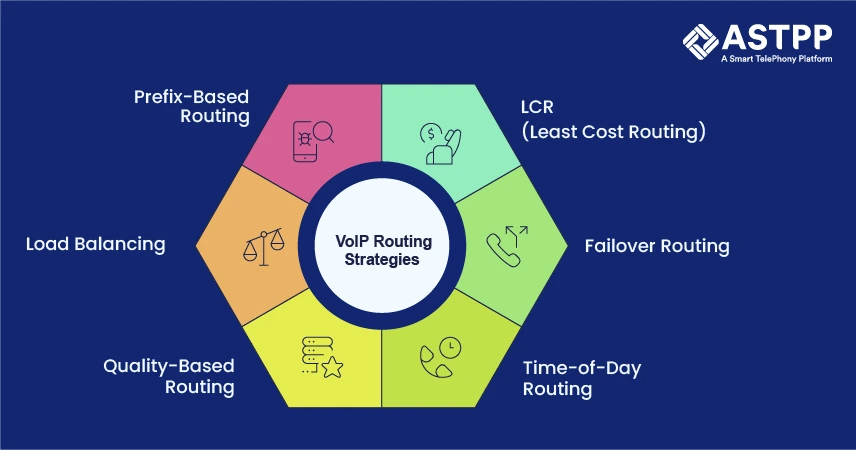
Modern telecom routing architecture design has evolved far beyond basic sequential dial plans. Today, advanced VoIP routing strategies are essential for operators competing on both cost efficiency and call quality.
1. VoIP Least Cost Routing (LCR): The Margin Engine
VoIP Least Cost Routing (LCR) is the process of selecting the lowest-cost carrier for each destination while maintaining defined quality thresholds. It is one of the most important routing techniques for wholesale VoIP operators.
A strong LCR engine evaluates multiple factors in real time, including:
- Carrier rate per minute based on destination prefix
- Current carrier quality metrics such as ASR (Answer Seizure Ratio), ACD (Average Call Duration), and PDD (Post Dial Delay)
- Carrier capacity and concurrent call limits
- Time-of-day and day-of-week rate variations
- Regulatory constraints by destination country
ASTPP’s LCR engine processes multi-level carrier priority groups and rate tables in real time, allowing operators to maintain optimal termination margins across large sets of destination prefixes. This becomes especially valuable for operators managing multiple active carriers, where automated LCR VoIP routing significantly reduces manual effort and improves efficiency.
People Also Read : Optimizing Call Routing with Least Cost Routing
2. Failover Routing: Protecting Uptime at Every Call Attempt
Failover routing automatically redirects a call to a secondary carrier when the primary route fails or drops below acceptable quality thresholds. For operators with strict SLA commitments, failover routing is a critical layer in any VoIP routing architecture.
Common failover triggers in a well-configured routing engine include:
- SIP 5xx responses indicating server-side carrier errors
- SIP 408 / timeout responses
- Dropped connections during an active call
- Carrier capacity exhaustion, where no ports are available
- ASR (Answer Seizure Ratio) falling below defined quality thresholds
ASTPP supports multi-tier failover sequencing, where carriers are arranged in priority groups. If a route fails, the system automatically moves to the next available carrier without dropping the call. This is especially important for operators handling emergency traffic or services that require strict regulatory uptime compliance.
3. Time-of-Day and Day-of-Week Routing: Rate Arbitrage at Scale
Carrier rates often vary based on peak and off-peak hours, weekdays and weekends, or even public holidays. Time-of-day routing allows operators to take advantage of these pricing differences by automatically directing traffic to the most cost-effective carrier during specific time periods.
This helps operators reduce termination costs without affecting service quality or requiring manual routing changes.
ASTPP’s routing engine supports time-based routing rules that can activate or deactivate specific carrier groups according to predefined schedules. This enables operators to optimize costs automatically while avoiding the complexity of manually updating routing or rate tables.

📘See How Blue Telecoms Optimized VoIP Call Routing with ASTPP
Discover how Blue Telecoms improved routing efficiency, call quality, and operational performance with ASTPP.
Inside this Case Study:
- Optimized VoIP routing workflows
- Improved call quality and reliability
- Enhanced operational efficiency
4. Quality-Based Routing: Protecting Revenue Through Call Completion
Intelligent call routing for VoIP platforms goes beyond cost optimization by using real-time performance metrics to determine the best route for each call. This approach evaluates ASR (Answer Seizure Ratio), ACD (Average Call Duration), and PDD (Post Dial Delay), automatically reducing the priority of carriers that do not meet predefined quality standards.
This is important because:
- Low ASR indicates poor call completion rates, leading to fewer billable minutes and lower customer satisfaction.
- High PDD increases the time it takes for calls to connect, causing users to abandon calls and increasing churn risk.
- Unusually short ACD can be a sign of fraudulent, artificial, or low-quality traffic.
ASTPP continuously calculates quality scores for each carrier and destination, incorporating these metrics into routing decisions. This helps operators maintain high call completion rates, improve customer experience, and ensure accurate revenue generation.
5. Load Balancing: Distributing Traffic Across Carrier Capacity
Load balancing distributes call traffic across multiple carriers using percentage-based or weight-based allocation rules. This helps operators avoid overloading a single carrier during traffic spikes while also meeting volume commitments with multiple termination partners.
Key benefits of load balancing include:
- Preventing carrier capacity exhaustion during periods of high traffic.
- Distributing traffic efficiently across multiple carriers.
- Supporting volume commitments and partner agreements.
- Reducing the impact of carrier-specific outages or service disruptions.
By spreading traffic across multiple providers, operators improve network resilience and maintain service continuity. ASTPP supports both static weight-based traffic distribution and dynamic load balancing based on real-time capacity and performance conditions, ensuring optimal traffic management at scale.
6. Prefix-Based and Destination-Specific Routing: Precision at the Dial Plan Level
Prefix-based routing allows operators to assign carriers based on specific destination prefixes rather than routing all traffic at the country level. This provides greater control over costs and call quality, especially for wholesale operators managing international traffic.
Rates and performance can vary significantly between different destinations within the same country, such as mobile and fixed-line networks. With destination-specific routing, operators can select the most appropriate carrier for each prefix instead of applying a single routing strategy to all traffic.
Key benefits include:
- More accurate carrier selection for specific destinations.
- Better control over termination costs.
- Improved call quality for different network types.
- Greater flexibility in managing international traffic.
Without prefix-level routing, operators risk paying higher termination costs or delivering inconsistent call quality. By enabling granular routing decisions, ASTPP helps operators optimize both margins and customer experience across a wide range of destinations.
Telecom Routing Architecture Design: What Carriers Need to Get Right

Effective VoIP call routing depends on a strong telecom routing architecture design. As operators scale their networks, early architecture decisions can significantly impact performance, reliability, and operational efficiency.
Key areas carriers need to address include:
- HA cluster deployment: A single softswitch creates a single point of failure. Carrier-grade environments require high-availability (HA) clusters with active-active or active-standby configurations to ensure continuous service.
- Session Border Controller (SBC) positioning: SBCs protect network edges by handling NAT traversal, topology hiding, and protocol normalization before calls reach the routing layer.
- CDR pipeline design: Routing and billing systems must work together seamlessly. Real-time synchronization between routing decisions and CDR processing helps prevent revenue leakage and billing discrepancies.
- Carrier gateway management: Operators must monitor and manage carrier trunks, capacity limits, and codec configurations to avoid routing traffic through degraded or overloaded gateways.
- Softswitch centralisation vs geographic distribution: Smaller networks often benefit from centralized management, while operators handling cross-regional traffic may use geographically distributed softswitches to reduce latency and improve performance.
ASTPP is built around these carrier-grade architecture principles. Its Class 4 softswitch manages both routing and CDR generation in real time, while the BSS billing layer processes CDR data for prepaid balance control and postpaid invoice generation. This integrated approach eliminates the need to connect separate routing, billing, and monitoring systems, simplifying operations and improving visibility across the network.
FreeSWITCH and OpenSIPS in Carrier Routing: Platform Choices and Business Implications
Two open-source platforms are widely used in carrier-grade routing: FreeSWITCH and OpenSIPS. Choosing the right platform depends on traffic volume, routing requirements, and operational needs.
1. FreeSWITCH Call Routing Configuration
FreeSWITCH call routing configuration uses XML dial plans to define call processing through condition-action rules. It is strong in media handling, making it ideal for Class 5 deployments that require transcoding, IVR, and call recording.
For Class 4 softswitch traffic, FreeSWITCH provides reliable routing but requires proper capacity planning as concurrent sessions grow.
ASTPP integrates natively with FreeSWITCH, converting complex dial plan management into a GUI-based routing interface. This allows operators to use FreeSWITCH’s media capabilities without managing raw XML files or relying on a dedicated FreeSWITCH engineer for routine routing changes.
2. OpenSIPS Routing Dialplan
OpenSIPS routing dialplan logic is built using a scripting language that provides granular control over SIP message handling at the proxy level. OpenSIPS is optimised for high-throughput SIP routing and is often the preferred choice for Class 4 environments, where call setup speed and high concurrent session capacity are priorities.
In ASTPP Class 4 deployments, the routing engine works alongside OpenSIPS, combining OpenSIPS proxy performance with ASTPP’s LCR and carrier priority logic. This enables carrier-grade throughput while allowing routing changes to be managed through ASTPP instead of manually editing dialplan scripts.
VoIP Scalability Solutions: How Routing Architecture Enables Business Growth
Routing is more than a cost-management tool. For operators focused on long-term growth, VoIP scalability depends on a routing infrastructure that can expand efficiently without requiring major architectural changes. Three key dimensions of scalability are critical:
1. Horizontal Carrier Scaling
Operators must be able to onboard new carriers and import rate tables without disrupting existing routing logic. ASTPP supports bulk carrier provisioning and live rate table updates, enabling seamless expansion with zero downtime.
2. Traffic Volume Scaling
Routing performance should remain consistent as call volumes increase. ASTPP’s Class 4 softswitch is engineered for carrier-grade concurrent call handling and supports high-availability (HA) clustering for operators that outgrow single-node deployments.
3. Multi-Tenant Routing Scaling
Service providers operating reseller businesses require independent routing policies for each reseller. ASTPP’s multi-tenant billing and routing architecture enables separate routing profiles, rate tables, and carrier assignments for every reseller tier, ensuring operational flexibility as the business grows.
Scalability, however, is not solely about handling more traffic. It also requires protecting revenue as network complexity increases.
Telecommunications operators lose billions of dollars annually to fraud, with a significant share attributed to routing manipulation, call pumping, and other traffic exploitation schemes. A routing platform without integrated fraud protection becomes a scalability risk rather than a growth enabler.
ASTPP addresses this challenge through built-in fraud detection and monitoring capabilities. The platform continuously analyzes routing anomalies, International Revenue Share Fraud (IRSF) patterns, and abnormal Answer-Seizure Ratio (ASR) deviations. Suspicious routing behavior can be automatically blocked or flagged for investigation, helping operators minimize losses before they escalate.
Intelligent Call Routing for VoIP Platforms: The AI and Automation Layer
The next stage in the evolution of intelligent call routing for VoIP platforms is the integration of machine learning and automation into route selection decisions. Traditional routing systems rely on predefined operator rules and static carrier priorities. In contrast, AI-assisted routing engines continuously analyze historical and real-time carrier performance data to identify the routes most likely to deliver the optimal balance of cost, quality, and call completion success.
Advanced routing platforms are increasingly incorporating capabilities such as:
- Predictive carrier scoring that evaluates carrier performance based on destination-specific and time-of-day quality trends.
- Automated route suppression that temporarily excludes carriers whose performance falls below predefined rolling quality thresholds.
- Anomaly detection that identifies unusual Call Detail Record (CDR) patterns associated with fraud, traffic pumping, routing errors, or carrier misconfigurations.
- Dynamic rate optimization that considers both current pricing and the predicted probability of successful call completion when selecting routes.
These capabilities allow operators to move beyond reactive routing management and toward data-driven, self-optimizing network operations.
For ASTPP users, the Demand-Based Routing add-on enhances traditional Least Cost Routing (LCR) by introducing adaptive routing logic that responds to real-time carrier quality indicators. Rather than relying solely on static routing tables, operators can automatically prioritize routes that consistently deliver better performance while reducing exposure to low-quality or unstable carriers.
This approach provides many of the operational benefits associated with AI-driven routing, improved call quality, better margin protection, and reduced manual intervention without the complexity and cost of developing a custom machine learning solution from scratch.
How ASTPP Brings Every Routing Technique Together in One Platform
Many operators pursuing routing optimization face a common challenge: platform fragmentation. Least Cost Routing (LCR) software comes from one vendor, the softswitch from another, billing from a third, and fraud management from yet another. Each integration introduces additional complexity, operational overhead, and potential points of failure within the call routing process.
ASTPP eliminates this fragmentation by providing a unified telecom platform where routing, switching, billing, fraud management, and reseller operations work together within a single architecture.
Because routing logic operates directly alongside real-time billing, carrier management, CDR processing, and fraud controls, routing decisions can be made faster and with greater context. The routing engine has immediate access to account balances for prepaid authorization, carrier quality metrics for performance-based route selection, and fraud policies for real-time traffic blocking all without relying on external API calls or third-party integrations.
This integrated approach reduces latency, simplifies operations, and enables operators to manage complex routing environments from a single platform.
Key Routing Capabilities in ASTPP
- Multi-level Least Cost Routing (LCR) with carrier priority groups and quality-weighted route selection.
- Prefix-based routing supporting thousands of destination codes and routing rules.
- Time-of-day routing and percentage-based traffic distribution for intelligent load balancing.
- Automated failover routing with configurable SIP response code triggers.
- Carrier capacity management with concurrent call limits and traffic controls.
- Real-time CDR generation and billing reconciliation integrated into the routing workflow.
- Demand-Based Routing for adaptive route selection based on carrier quality signals.
- Integrated fraud detection embedded directly within the call routing decision process.
- Multi-tenant routing architecture supporting independent routing profiles for reseller and wholesale operations.
The result is a routing environment where cost optimization, quality assurance, billing control, and fraud prevention operate as coordinated components rather than disconnected systems.
ASTPP is used by more than 20,000 telecom operators across 95+ countries, including wholesale carriers, regional ITSPs, SIP trunking providers, and VoIP service operators. Its open-source architecture gives organizations full control over routing behavior and business logic, eliminating dependency on proprietary vendor roadmaps. Operators can customize routing workflows, integrate specialized requirements, and adapt the platform to evolving business models without sacrificing operational efficiency.
As routing strategies continue to evolve toward real-time optimization and AI-assisted decision-making, a unified platform architecture becomes increasingly important. By bringing routing, billing, switching, fraud management, and multi-tenant operations together in a single system, ASTPP provides a foundation that supports both current operational requirements and future network growth.
When to Hire a VoIP Developer for Custom Routing Requirements
Modern VoIP platforms provide extensive routing capabilities that address the vast majority of carrier, wholesale, and service provider requirements. Features such as Least Cost Routing (LCR), quality-based routing, failover management, load balancing, and fraud controls are typically sufficient for standard operational scenarios.
However, there are situations where engaging a VoIP developer for custom routing development becomes a strategic investment rather than an operational expense.
Organizations may benefit from custom development when they need to:
- Build proprietary routing algorithms that provide competitive differentiation beyond standard platform capabilities.
- Integrate routing decisions with external systems, such as CRM, ERP, OSS/BSS, or proprietary billing platforms through custom APIs and business logic.
- Implement destination-specific compliance controls, including regulatory validation, STIR/SHAKEN verification workflows, or jurisdiction-specific routing policies.
- Develop advanced CLI manipulation and number normalization rules for specialized international termination and interconnect scenarios.
- Create custom analytics and reporting frameworks that correlate routing decisions, carrier performance, quality metrics, and revenue outcomes.
- Automate complex operational workflows that require routing decisions to be influenced by external business events, customer profiles, or network conditions.
The key consideration is whether the required functionality creates measurable business value that cannot be achieved through standard platform configuration alone. In many cases, configuration-based routing remains the most cost-effective and maintainable approach. Custom development is most appropriate when routing logic becomes a core component of an operator’s competitive strategy.
For organizations using ASTPP, custom routing development is supported by the platform’s open-source architecture. Unlike proprietary SaaS billing and routing platforms that restrict access to core routing logic, ASTPP provides full visibility into the routing layer, allowing developers to extend, customize, and optimize routing behavior according to specific business requirements.
Additionally, organizations that require specialized routing enhancements can leverage professional development services from Inextrix Technologies to design, implement, and maintain custom routing functionality while preserving compatibility with the broader ASTPP ecosystem.
By combining configurable routing capabilities with access to source code and professional development expertise, operators can choose the level of customization that best aligns with their technical requirements, operational complexity, and growth objectives.
Conclusion: Routing Intelligence Is Revenue Intelligence
For VoIP operators, routing is far more than a technical function. It directly influences profitability, call quality, customer experience, and business scalability. Every call requires a routing decision that balances cost, performance, and reliability. Techniques such as Least Cost Routing (LCR), failover routing, quality-based routing, load balancing, and prefix-level control help operators optimize margins while maintaining consistent service quality.
The real advantage comes from managing these capabilities within a unified platform. ASTPP brings routing, billing, carrier management, fraud detection, and reseller operations together in a single architecture, allowing routing decisions to be made using real-time business and network intelligence rather than disconnected systems and manual processes.
As competition increases and traffic volumes grow, intelligent routing becomes a strategic business asset rather than a back-office necessity. Operators that invest in advanced routing capabilities and scalable infrastructure are better positioned to protect revenue, improve customer satisfaction, and build sustainable growth without the need for costly re-platforming in the future.
Ready to deploy carrier-grade VoIP call routing for your telecom business?


