 Introducing iCallify Built by ASTPP’s Engineering Team to Power Modern Contact Centers

Quick Summary: Real-time VoIP billing gives telecom businesses immediate visibility into usage, charges, balances, and revenue. This guide explains why real-time billing is critical for growth, helping providers improve cash flow, prevent revenue leakage, automate charging, strengthen customer control, and make decisions.
Running a VoIP business at scale means handling thousands of concurrent calls, multiple carrier routes, prepaid and postpaid accounts, and reseller hierarchies simultaneously. One billing delay, one inaccurate CDR, one missed fraud event: each costs money that is never recovered. That is the core problem with post-call or batch billing. By the time the error surfaces, the revenue has already gone. Real-time VoIP billing closes that window. It processes charges as calls happen, not after the fact, giving operators full financial control at every moment of network activity.
This matters more than ever. The global VoIP services market is estimated to be valued at US$ 201.97 Bn in 2026 and is expected to reach US$ 472.21 Bn by 2033, exhibiting a compound annual growth rate (CAGR) of 12.9% from 2026 to 3033. Operators competing in that environment cannot afford billing architectures built for a slower era. Whether you are running a wholesale carrier business, an ITSP, or a SIP trunking operation, the speed and accuracy of your billing engine directly affect your margins, your fraud exposure, and your capacity to grow.
This post breaks down what real-time VoIP billing means in practice, why batch billing creates compounding problems for growing operators, and how a properly implemented online charging system for VoIP changes the revenue picture for telecom businesses.
What Real-Time VoIP Billing Means
The term Real-time VoIP billing means charges are calculated and applied while a call is active, not after it ends. The billing engine continuously communicates with the online charging system for VoIP, deducting balance during the call instead of applying one charge at the end.
In a prepaid setup, the platform checks the caller’s balance at the start of the call, calculates the allowed call duration based on the current rate, and ends the call when the balance is exhausted. This prevents overruns, disputes, and write-offs.
In a postpaid setup, usage is tracked live against credit limits. Automated alerts or spending caps can be triggered before an account exceeds its limit.
The key component behind this process is the online charging system for VoIP (OCS). The OCS sits between the softswitch and the billing database, authorizing call sessions in real time and managing balance updates during the call.
Nibble Billing: The Detail That Separates Serious Operators from the Rest
Most operators understand per-second billing, but fewer focus on how balances are deducted during a live call.
Nibble billing deducts balance in small increments throughout the call instead of charging everything at the end. This allows the system to continuously verify that enough balance remains to keep the call active.
If a platform authorizes the entire call upfront and checks the balance only after the call ends, it is not performing real-time billing. It is using deferred billing with a short delay.
In practice, nibble billing is what prevents prepaid overruns. By updating balances continuously during the call, operators can stop calls when funds are exhausted and avoid revenue leakage.
The Real Cost of Batch Billing for Telecom Operators

Batch billing processes CDRs on a schedule such as hourly, daily, or after a call ends. While this may work for small operations handling a few hundred calls per day, it becomes risky for operators managing thousands of concurrent sessions. The result is often revenue leakage in telecom that grows over time.
Here are the most common areas of exposure:
- Prepaid Overruns: A customer with limited balance can make a long international call. If billing is applied only after the call ends, the operator absorbs the excess cost. Across hundreds of accounts, these overruns can become a significant monthly write-off.
- Fraud Blind Spots: Fraud schemes such as International Revenue Share Fraud (IRSF) and traffic pumping depend on keeping high-volume calls active for as long as possible. Batch billing creates a delay before suspicious activity is detected, giving fraudsters more time to generate losses.
- Credit Limit Failures: For postpaid customers, usage can exceed credit limits between billing cycles. Operators may not discover the breach until after the charges have already accumulated.
- Higher Dispute Volume: When billing records do not align with real-time call activity, customers are more likely to question their invoices. Resolving disputes increases support costs and can contribute to customer churn.
- Audit Complexity: Operators that must meet regulatory reporting requirements need billing records that accurately match CDR data. Batch billing often creates reconciliation challenges and audit gaps.
Also Read: How Real-Time Billing Helps Telecom Businesses Prevent Revenue Leakage
Business Impact: What Operators Gain from Real-Time Billing

The benefits of real-time billing are practical and measurable. Operators that move away from batch billing often see improvements in profitability, fraud control, scalability, and operational efficiency.
1. Margin Protection on Every Call
A real-time billing and routing system knows the cost and revenue of a call while it is in progress. This allows operators to enforce routing policies that protect margins instantly.
If carrier quality drops or rates change, the LCR engine and billing platform can react immediately instead of waiting for the next billing cycle. This helps prevent avoidable losses and keeps routing decisions profitable.
2. Fraud Detection That Actually Works
Real-time billing supports live fraud monitoring. An online charging system for VoIP can detect unusual calling patterns, high-risk destinations, or abnormal spending behavior as soon as they occur.
This can mean stopping a fraud attack within minutes rather than discovering it days later through CDR analysis and billing reports.
3. Multi-Tenant Billing That Scales
For operators managing reseller networks, real-time billing provides accurate balance and usage data across every level of the hierarchy.
A multi-tenant VoIP billing platform allows resellers to view customer usage in real time, reducing manual account reconciliation and making telecom billing automation scalable as the business grows.
4. Operational Efficiency Across the Stack
Real-time billing works alongside other core functions of a VoIP billing platform for telecom operators, including rate management, DID provisioning, invoice generation, and payment processing.
- Because billing data is always up to date:
- Support teams see accurate account information.
- Finance teams can close billing cycles faster.
- Operations teams spend less time resolving billing discrepancies.
The result is a more efficient workflow across the entire organization.
Key Capabilities in a Real-Time VoIP Billing System
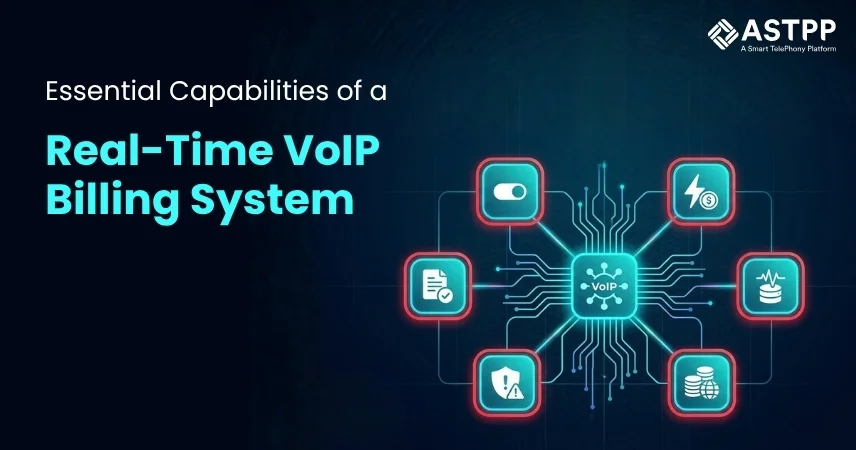
Not every VoIP billing software platform provides true real-time billing. A genuine real-time billing architecture should include the following capabilities:
- Nibble Billing Engine: Supports incremental mid-call balance deduction instead of applying charges only after the call ends. This is essential for accurate real-time billing and prepaid control.
- Online Charging System (OCS): A dedicated Online Charging System for VoIP that communicates with the softswitch during each call session, authorizing usage and updating balances in real time.
- Prepaid Balance Management: Enforces account balances live and automatically terminates calls when funds are exhausted, preventing prepaid overruns.
- Credit Limit Controls: Applies daily, monthly, or account-level spending limits in real time for postpaid customers, helping operators control credit exposure.
- Live CDR Processing: Generates and stores Call Detail Records (CDRs) in real time rather than relying on post-call batch processing, improving billing accuracy and visibility.
- Fraud Detection Integration: Integrates billing data with fraud monitoring systems to support spend velocity checks, destination anomaly detection, and automatic account suspension when suspicious activity is detected.
- Rate Engine Accuracy: Provides accurate per-second billing, proper rounding logic, and free-minute handling to ensure correct charging and prevent revenue leakage.
- Multi-Currency and Multi-Tenant Support: Supports real-time billing across multiple currencies and reseller levels, making it suitable for complex operator and multi-tenant environments.
Together, these capabilities separate basic VoIP billing software from a fully featured real-time VoIP billing system designed for telecom operators and service providers.
How ASTPP Delivers Real-Time VoIP Billing for Telecom Operators
ASTPP is designed as a VoIP billing platform for telecom operators, with real-time billing built into the core of the platform. It processes every call in real time rather than relying on post-call billing methods.
1. Native OCS with Nibble Billing
ASTPP includes a built-in online charging system for VoIP (OCS) that authorizes and manages balances during active call sessions.
Its nibble billing engine deducts charges incrementally throughout the call, preventing prepaid users from consuming unauthorized credit. The platform also handles free-minute bundles accurately by splitting usage between bundled minutes and standard billed minutes in real time, without rounding errors.
2. Automated Invoice and CDR Processing
Every call generates a CDR in real time. These records flow directly into the telecom billing automation engine, which automatically manages invoice generation, payment cycles, and account reconciliation.
Operators can configure weekly, monthly, or custom billing schedules for different accounts, all without manual processing.
3. Fraud Detection Tied to Billing Data
ASTPP’s fraud monitoring uses live billing information instead of relying solely on post-call CDR analysis.
Unusual spending patterns, high-risk destinations, and call velocity anomalies can trigger alerts or automatic account suspension in real time, helping operators stop fraud while a call is still active.
4. Multi-Tenant Reseller Billing
ASTPP supports multi-level reseller hierarchies with real-time balance and usage visibility at every level.
Resellers can monitor customer activity as it happens, while operators can enforce credit policies across the hierarchy. Billing data flows accurately through the entire account structure, making telecom billing automation practical at scale.
5. Deployment Flexibility
ASTPP can be deployed on-premises, in the cloud, or in high-availability (HA) cluster environments.
The real-time billing and routing system operates consistently across all deployment models, ensuring billing continuity for operators that require high availability and uninterrupted service.
Real Business Use Cases
The following examples show how real-time VoIP billing helps different telecom businesses improve revenue accuracy, automate billing, and maintain complete control over customer accounts.
1. Wholesale VoIP Carrier: Protecting Margins on High-Volume Traffic
A wholesale VoIP carrier handling millions of minutes each month cannot rely on batch billing. At high traffic volumes, even small CDR inaccuracies can lead to significant revenue loss or billing disputes.
With ASTPP’s real-time billing engine, every call is tracked, rated, and recorded as it ends. LCR routing decisions are made within the same platform, ensuring the least-cost route is matched with the correct billing rate and helping protect margins on every call.
2. ITSP Running Prepaid Retail Accounts
An ITSP managing thousands of prepaid subscribers needs strict control over account balances. Batch billing cannot guarantee that customers will stay within their available credit.
ASTPP’s online charging system for VoIP enforces balance limits during active calls, automatically terminates calls when credit reaches zero, and supports Stripe auto-refill to keep customer accounts funded without manual intervention.
3. Reseller Network with Multi-Level Billing
A VoIP billing platform for telecom operators managing reseller networks requires billing visibility at every level of the hierarchy.
ASTPP’s multi-tenant architecture supports up to four account tiers including Super Admin, Admin, Reseller, and Customer with separate billing rules and controls for each level.
Resellers can monitor customer usage in real time, reducing support requests and improving account management across the network. At the same time, operators maintain full visibility and control over billing throughout the entire reseller hierarchy.
Conclusion:
The difference between batch billing and real-time VoIP billing is more than a technical detail. It affects how much control an operator has over revenue, fraud, and customer billing.
Every prepaid overrun, delayed fraud detection event, and disputed invoice can result in lost revenue. A proper online charging system for VoIP helps prevent these issues by tracking usage, enforcing limits, and applying charges while calls are still in progress.
As telecom businesses grow, they need a VoIP billing platform for telecom operators that can process charges in real time, enforce balance and credit limits instantly, and connect billing with routing decisions in a single system.
ASTPP is built on this architecture and is trusted by more than 20,000 operators across 95+ countries.
If you are evaluating VoIP billing software or planning to replace a legacy billing platform, the most important question is not simply which features are available. The real question is whether the billing engine operates in real time from start to finish.
Ready to see real-time VoIP billing in action?


