 Introducing iCallify Built by ASTPP’s Engineering Team to Power Modern Contact Centers

Quick Summary: Real-time billing helps telecom businesses identify usage discrepancies, prevent undercharging, and reduce revenue leakage before losses accumulate. This guide explains how real-time charging, monitoring, automated rating, and accurate usage tracking improve revenue protection, billing accuracy, financial control, and overall business profitability.
Telecom operators operate on very tight margins. With millions of call minutes, complex reseller networks, and both prepaid and postpaid customers to manage, even small billing errors can have a big impact.
Real-time VoIP billing software helps address these issues by ensuring every call is rated and charged instantly, improving control and accuracy across the entire billing lifecycle.
As a result, revenue is often lost not only due to fraud or churn, but because of gaps in billing processes and delayed reconciliation.
According to a research, global telecom operators fail to collect an estimated 7% of the revenue they are owed due to billing process gaps, system errors, and misconfigured tariffs. With the Communications Fraud Control Association reporting $38.95 billion in telecom fraud losses in 2023, the need for better preventing revenue leakage in telecom strategies has never been greater.
The solution is not hiring more auditors or spending more time on manual reconciliations. Instead, telecom operators need a real-time VoIP billing system that detects and prevents billing issues as they happen, rather than discovering them weeks later.
In this article, we explore how a carrier-grade VoIP billing platform like ASTPP improves VoIP billing accuracy, reduces leakage, and strengthens revenue control using VoIP billing automation solutions and an integrated online charging system (OCS) for VoIP.
What Revenue Leakage Costs Telecom Operators
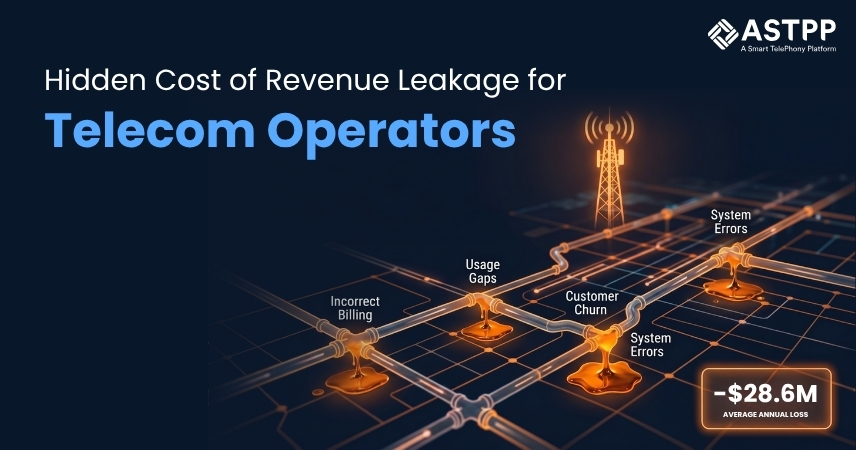
Revenue leakage in telecom often comes from comes from small errors hidden within everyday operations. These issues are difficult to detect without a telecom revenue assurance software layer that continuously monitors billing accuracy.
It can happen when:
- A call record never reaches the call detail record (CDR) billing system.
- A discount is applied to the wrong rate plan.
- A roaming service is provided but not billed.
- A bundled service is priced incorrectly during provisioning.
Individually, these issues may seem minor. But across thousands or millions of transactions, they can result in significant revenue loss and directly impact profitability.
Revenue leakage is one of the biggest financial challenges in telecom. Studies show that operators fail to collect about 7% of the revenue they earn, resulting in annual losses of roughly $2.3 billion.
The most common leakage points that operators face include:
- Unbilled CDRs: Call detail records that fail to reach the billing engine due to mediation gaps, dropped connections, or system timeouts.
- Misconfigured rate plans: Tariff tables that apply incorrect rates, especially for wholesale routes with complex per-second or per-minute billing.
- Delayed rating cycles: Batch billing systems that process usage hours or days later, leaving no window to intercept fraud or over-delivery.
- Reseller billing gaps: Incorrect margin calculations in multi-tier reseller hierarchies where each tier has different rates and credit limits.
- Fraud without real-time controls: IRSF, SIM-box bypass, and account takeover schemes that run undetected for hours before manual review catches them.
Why Batch Billing Leads to Revenue Leakage
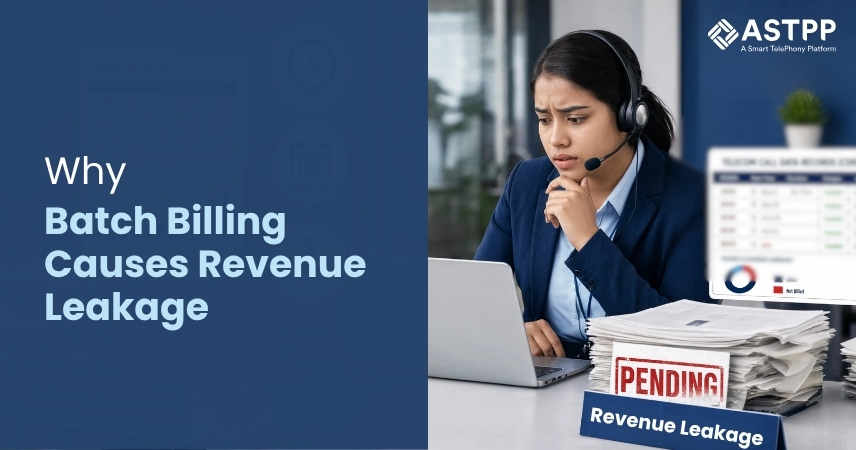
Traditional batch billing systems were built for a time when telecom services were simpler, pricing was more predictable, and transaction volumes were lower. In that environment, processing billing data once a day was often sufficient.
Today’s operators require VoIP billing automation solutions that handle prepaid, postpaid, wholesale, and reseller traffic simultaneously.
Billing errors and discrepancies may not be discovered until the end of a billing cycle, by which time revenue has already been lost and the information needed to investigate the issue may be difficult to recover.
The key problems with batch billing:
- Late error detection: Billing or CDR errors are often found only after the billing cycle ends, making them harder to fix.
- Delayed fraud detection: Fraudulent calling activity can continue for an entire billing cycle before it is noticed.
- No real-time credit control: Prepaid users may exceed their balance if credit limits are not checked during each call.
- High reconciliation workload: Billing disputes, adjustments, and unresolved CDRs build up over time, increasing operational effort.
This is why operators are shifting to a real-time VoIP billing system, where every event is processed instantly instead of waiting for batch cycles.
How a Real-Time Billing System Prevents Revenue Leakage

Real-time VoIP billing system is more than just a faster version of batch billing. Instead of processing usage records at scheduled intervals, it processes every billable event as it happens, enforces limits instantly, and improves telecom revenue optimization strategies.
Here is how each component of a real-time billing system addresses a specific type of revenue leakage:
- Continuous CDR Processing: Every call generates a Call Detail Record (CDR) when it starts and ends. In a real-time call detail record (CDR) billing system, these records are processed immediately instead of waiting for a billing cycle. This ensures that every call is recorded, rated, and billed without delay, reducing the risk of lost or unbilled usage.
- Online Charging System (OCS) for Prepaid Control: For prepaid services, the Online Charging System (OCS) for VoIP checks a customer’s balance before a call begins, reserves the required credit, and updates the balance as soon as the call ends. This prevents customers from making calls they cannot pay for and eliminates revenue loss caused by delayed balance checks.
- Real-Time Fraud Detection: Fraud often succeeds because there is a delay between when a call occurs and when suspicious activity is detected. A carrier-grade VoIP billing platform monitors calling activity continuously and can automatically flag or block unusual patterns before significant losses occur.
- Automated Tariff Validation:Incorrect rate plans can lead to underbilling and lost revenue. Telecom billing software validates tariffs during the rating process and identifies configuration errors immediately, preventing large-scale billing mistakes.
- Multi-Tier Reseller Billing: For operators with reseller networks, real-time VoIP billing system applies the correct rates, margins, and credit limits at every reseller level. With advanced VoIP billing automation solutions, it ensures accurate charging across the entire hierarchy and removes the need for complex batch reconciliations.
Telecom Revenue Assurance Software: What Operators Should Look For
Not every billing platform marketed as ‘real-time’ delivers genuine event-driven rating. Many systems claim real-time capabilities but still process CDRs in micro-batch cycles of several minutes. For operators managing high call volumes or thin-margin wholesale routes, even a few minutes of delay can translate into material leakage.
When evaluating telecom revenue assurance software, operators should assess these specific capabilities:
- True event-driven rating: CDRs rated per call, not per batch interval, no matter how short
- Integrated OCS: Online Charging System with real-time balance reservation and deduction, not post-call charging
- CDR completeness monitoring: Automated detection of missing or duplicate CDRs before they reach invoicing
- Rate plan conflict detection: Tariff validation at the point of rating to catch configuration errors before they affect revenue
- Multi-currency and multi-tenant support: Essential for wholesale operators serving resellers in multiple geographies
- Fraud threshold automation: Configurable per-account and per-route thresholds with automated blocking
- Audit trail and CDR re-rating: Ability to re-rate historical CDRs when tariff corrections are made
The distinction between a billing system and a revenue assurance platform matters here. Billing generates invoices. Revenue assurance ensures that every invoiceable event is captured, correctly rated, and successfully collected. A carrier-grade VoIP billing platform needs to do both.
How ASTPP’s Real-Time Billing System Addresses Revenue Leakage
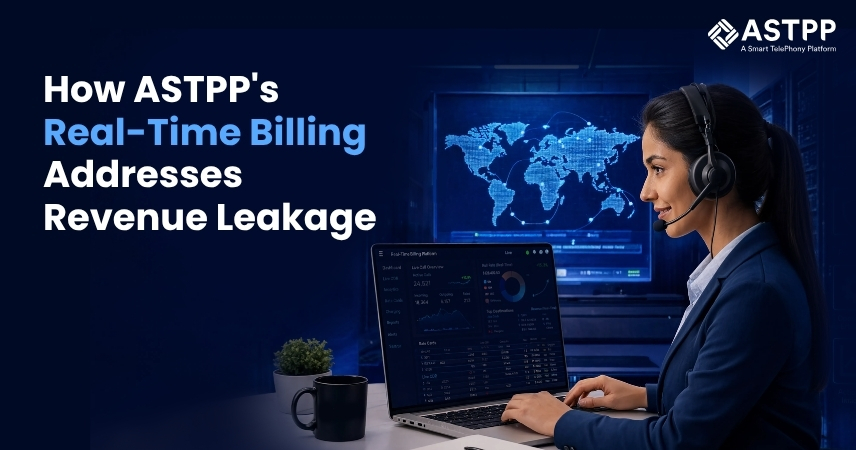
ASTPP is built as a carrier-grade VoIP billing platform that integrates real-time billing directly into the call routing infrastructure. This is a different architecture from platforms that add billing as a downstream module. In ASTPP, billing is part of the call flow, not a post-processing step.
ASTPP’s key capabilities for preventing revenue leakage include:
1. Integrated Online Charging System (OCS)
ASTPP’s OCS manages prepaid account balances with real-time authorization. Before a call is allowed to proceed, the OCS validates the account balance, reserves the required credit, and sets the maximum permitted call duration. At disconnection, the exact charge is applied and the balance updated. There is no lag, no batch window, and no risk of calls completing without balance coverage.
2. Call Detail Record (CDR) Billing System and Re-Rating Engine
ASTPP captures CDRs for every call and processes them through the rating engine in real time. The platform supports CDR re-rating, allowing operators to correct historical billing when rate plan changes are made or errors are identified. Every CDR is stored with full detail for audit purposes.
3. Multi-Level Reseller Billing with Real-Time Margin Control
ASTPP supports multi-tier reseller hierarchies where each tier has independent rate plans, credit limits, and billing configurations. Real-time billing applies to every level of the hierarchy. A reseller’s credit limit is enforced before calls proceed, not after a batch reconciliation discovers an overage.
4. Fraud Detection with Automated Threshold Controls
ASTPP includes configurable fraud detection thresholds at the account, route, and system level. When calling patterns exceed defined thresholds, calls can be blocked automatically or flagged for operator review. Combined with real-time CDR processing, this closes the detection window that fraud schemes rely on.
5. VoIP Billing Accuracy Through Automated Tariff Management
ASTPP’s tariff management system supports complex rate structures including per-second billing, tiered rates, time-of-day pricing, and destination-specific rates. Rate conflicts are flagged at the point of application rather than discovered post-cycle. This is directly relevant to VoIP billing accuracy for operators managing hundreds of routes and multiple reseller tiers.
People Also Read: Definitive Guide to a VoIP Billing Solution
Real-World Application: Wholesale Carrier Protecting Margins at Scale
Consider a mid-sized wholesale VoIP carrier routing 20 million minutes monthly across 50 carrier routes. With margins of $0.002 per minute, total monthly revenue sits at $40,000. A 3% revenue leakage rate, within industry norms, represents $1,200 in monthly losses or $14,400 annually.
The leakage sources in this scenario are predictable: some CDRs fail to reach the rating engine due to mediation gaps, some calls complete on routes where the tariff was misconfigured after a carrier rate change, and some prepaid resellers exceed their credit limits during off-hours when manual monitoring is not active.
With a real-time VoIP billing system:
- Every CDR is processed immediately, eliminating mediation gap losses.
- Tariff validation at the point of routing catches misconfiguration before it affects a batch of calls.
- Prepaid reseller credit limits are enforced per-call, not per-cycle.
- Fraud detection thresholds identify unusual per-route calling spikes within minutes rather than the next business day.
At the same scale, the operator also gains operational efficiency. Manual reconciliation time drops, billing dispute resolution accelerates, and the operations team has continuous visibility into CDR completeness and revenue flow rather than a monthly retrospective.
Telecom Revenue Optimization Strategies Beyond Billing Accuracy

Reducing revenue leakage is only the first step. A real-time VoIP billing system can also help operators increase profitability and make smarter business decisions.
- Dynamic Routing Optimization: Real-time billing allows routing decisions to consider both call costs and billing accuracy. If a route has outdated or incorrect pricing, the system can automatically avoid it, preventing billing errors and protecting margins.
- Upsell Opportunities: With real-time balance monitoring, operators can identify prepaid customers who are close to their limits and offer plan upgrades or top-up options before service is interrupted.
- Better Profitability Analysis: Continuous access to CDR data gives operators a clear view of profitability by customer, route, and destination. This helps improve pricing strategies and identify high-value traffic.
- Easier Compliance: A complete real-time audit trail of call records makes it easier to meet regulatory requirements and respond to audits or reporting requests.
As telecom operators face increasing price pressure and declining average revenue per user (ARPU), protecting and maximizing existing revenue becomes critical. Real-time billing is not just about accurate invoicing, it is a tool for improving margins, increasing revenue visibility, and supporting long-term profitability.
Conclusion
Revenue leakage cannot be solved simply by increasing reconciliation efforts. It requires a real-time billing system that processes CDRs instantly, enforces charging rules during every call, and continuously monitors for fraud.
The impact of revenue leakage can be substantial. Industry estimates suggest operators lose between 1.9% and 7% of revenue due to billing errors, fraud, and operational gaps. For wholesale carriers with tight margins, these losses can significantly affect profitability.
ASTPP’s carrier-grade real-time VoIP billing system addresses this directly: event-driven CDR processing, an integrated Online Charging System (OCS) for VoIP, automated fraud detection, and multi-tier reseller billing that enforces accuracy at every level of the operator’s business structure. It is built for the operators who cannot afford to bill incorrectly and cannot afford to find out they did a month too late.


