 Introducing iCallify Built by ASTPP’s Engineering Team to Power Modern Contact Centers

Quick Summary: ASTPP vs PortaOne compares two VoIP billing platforms to help telecom operators evaluate their features, billing flexibility, scalability, customization options, and suitability for business needs. Understand key differences to choose the right billing solution for your telecom business.
Every telecom operator looking for a VoIP billing platform will likely consider PortaOne. With more than two decades in the market, PortaOne is known for carrier-grade reliability and is included in many wholesale and retail VoIP billing RFPs. However, a strong reputation does not always mean the platform is the right fit.
The ASTPP vs PortaOne decision often comes down to three practical questions: How much will it cost at your scale? How quickly can you get it up and running? And how easily can you customize the platform to match your business model?
The global VoIP services market was valued at USD 176.16 billion in 2025 and is expected to reach USD 388.97 billion by 2034, growing at a CAGR of 10.4 percent, according to Fortune Business Insights.
Operators entering or expanding in this market need to look beyond brand recognition when choosing VoIP billing software.
This guide compares PortaOne and ASTPP, looking at their pricing, deployment, flexibility, and overall fit for growing operators. It also explores how ASTPP, as an open-source VoIP billing solution, can address some of the challenges operators may face with traditional billing platforms.
What Operators Are Actually Comparing
Look beyond the marketing, and a VoIP billing platform comparison between ASTPP and PortaOne comes down to four key areas: licensing, deployment time, architecture, and codebase access.
- Licensing model:PortaOne uses enterprise licensing based on modules and scale, which can increase costs for mid-sized operators. ASTPP offers an open-source core (AGPLv3), along with an enterprise edition for teams that need support and advanced modules.
- Deployment timeline:PortaOne implementations for wholesale carriers can take 12 to 18 months from contract to go-live. ASTPP deployments, including HA cluster migrations, can typically be completed in weeks.
- Architecture:Both platforms support Class 4 and Class 5 softswitch However, they use different technology stacks, which affects how much an operator’s engineering team can customize and manage.
- Codebase access:PortaOne is closed source, while ASTPP gives operators direct access to the code. This allows operators to customize the platform based on their business needs instead of working within fixed platform limits.
This does not mean PortaOne is a poor platform. Large, established carriers with larger IT budgets and longer procurement processes have used it for years. The difference becomes more important for wholesale carriers, ITSPs, and SIP trunking providers that need faster deployment and better control over costs and customization.
Total Cost of Ownership: What Actually Drives the Number
License fees are only part of the cost. The bigger expenses often come from three areas:
- Implementation services:A 12-to-18-month PortaOne rollout can mean months of consultant and integrator fees before the platform starts generating revenue.
- Change requests:On a closed platform, custom rate plans, integrations, or reseller structures that are not part of the standard setup may require vendor change requests. These extra costs can add up.
- Scaling cost:Enterprise licensing based on modules or call volume can increase costs as the business grows. This is not ideal for operators looking for a billing platform that supports growth without rising platform costs.
ASTPP’s open-source core removes the core platform license cost. Its enterprise edition offers support and advanced modules separately, so operators can choose the services they need instead of paying enterprise licensing rates for features they may never use.
Class 4 Softswitch Comparison: Where the Architecture Actually Differs

A Class 4 Softswitch comparison between the two platforms mainly comes down to how they are built and managed. PortaSwitch uses a proprietary stack developed and maintained by PortaOne. This means feature requests, integrations, and customizations generally follow the vendor’s release process.
ASTPP takes a different approach. It is built as FreeSWITCH billing software, with FreeSWITCH serving as the open-source telephony engine for core switching and media handling. ASTPP sits on top of it to manage billing, rating, and business logic.
This approach offers several practical benefits for operators:
- Faster customization cycles:FreeSWITCH is a mature and well-documented platform. ASTPP’s expert teams and third-party developers can build and customize solutions without having to wait for a vendor roadmap.
- No black-box switching layer:Operators can inspect and troubleshoot the underlying switching layer when dealing with call quality or routing issues, rather than relying entirely on vendor support.
- Interoperability:FreeSWITCH supports a wide range of protocols, making it easier to connect with existing SIP infrastructure, carriers, and third-party systems.
Both platforms support Class 4 wholesale transit traffic and Class 5 retail features such as voicemail, IVR, and DID management. The key difference is the level of control operators have over the platform and how quickly they can make changes.
Industry Challenges Operators Face When Evaluating a Billing Platform
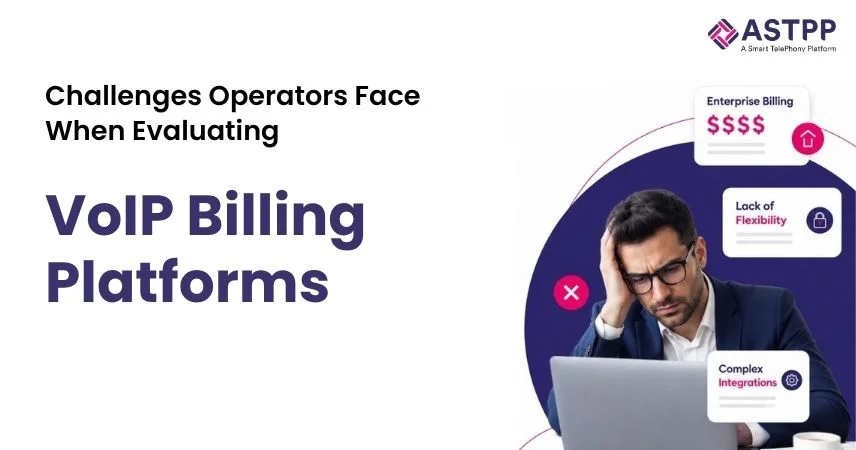
Any telecom billing platform comparison often highlights the same challenges. Operators evaluating billing platforms may already be dealing with one or more of these issues:
- Revenue leakage:Unbilled calls, rate mismatches, or CDR gaps can lead to lost revenue, especially when the platform cannot reconcile data in real time.
- Thin margins:Poor routing decisions can reduce margins when routes are not regularly optimized based on current carrier rates.
- Vendor lock-in:With a closed platform, every customization or change may require a support request, which can slow down implementation.
- Rigid licensing:Module- or scale-based licensing can make costs harder to predict as the business grows.
- Long implementation cycles:Lengthy deployments can delay time to revenue, which can be a major challenge for operators launching new services or migrating from another platform.
- Limited CDR visibility:Limited access to CDR data can make billing disputes, reporting, and audits more difficult to manage.
These challenges are often what lead operators to explore alternatives to their existing billing platforms. They also explain why PortaOne and ASTPP are commonly considered when operators evaluate different billing solutions.
Business Impact: Why the Platform Choice Compounds Over Time
The cost of a billing platform is more than its license fee. It also includes the impact of delays, ongoing costs, and limitations that can affect the business over time.
- Time to revenue:If a platform takes a year to implement, the operator may have to wait longer before generating revenue from the new deployment.
- Operational cost:Enterprise licensing based on usage or volume can increase costs as the operator grows, making it harder to predict expenses.
- Routing margin:Even small inefficiencies in least cost routing can add up when managing millions of minutes.
- Customization debt:Workarounds created to overcome platform limitations can become technical debt that requires ongoing maintenance.
Operators that move away from rigid, closed platforms may see changes such as lower total cost of ownership and faster product development. These factors may not appear in a standard feature comparison, but they can affect the company’s overall financial performance.
There is also a talent cost to consider. Developers working with a closed enterprise platform may need vendor-specific training before making major changes. With a FreeSWITCH-based platform like ASTPP, developers can use skills that apply across the wider open-source telephony ecosystem. This can give operators access to a broader talent pool and make it easier for new team members to get started.
Key Features and Strategies to Evaluate in Any VoIP Billing Software Comparison

When running a VoIP billing software comparison, whether it is ASTPP vs PortaOne or any other platform, operators should focus on these key areas:
- Real-time billing and OCS:Calls should be rated and charged as they happen instead of being processed later.
- Least Cost Routing (LCR):The routing engine should support multiple carriers and automatically select the most cost-effective route for each call.
- Multi-tenantand multi-level reseller billing: The platform should support reseller hierarchies as a built-in feature rather than requiring additional solutions.
- CDR processing and reporting:Every call detail record should be easy to track, audit, and export without depending on vendor support.
- Fraud detection:The platform should identify rate spikes, unusual calling patterns, and account activity before they result in financial losses.
- HA deploymentand geographic redundancy: Wholesale carriers handling high call volumes need redundancy to reduce the risk of service disruptions and single points of failure.
- Deployment flexibility:Cloud, on-premises, and hybrid deployment options give operators more flexibility to meet infrastructure and regulatory requirements.
- Support model:Community support can work for teams with strong in-house VoIP expertise. Growing operators may prefer a paid support plan with defined response times, making an enterprise edition useful for teams that need additional support.
How ASTPP Solves This

ASTPP was built to bridge the gap between developer-focused open-source tools and expensive enterprise platforms designed for large carriers. As a VoIP billing platform for telecom operators, ITSPs, and wholesale carriers, it combines:
- Open-source flexibility:ASTPP offers an AGPLv3 community edition and an enterprise edition with advanced modules and support.
- Class 4 and Class 5 softswitch:The platform combines Class 4 and Class 5 softswitch capabilities with real-time billing, LCR, SBC, fraud detection, CDR processing, and DID management in one platform. This reduces the need to connect multiple separate systems.
- Multi-tenant architecture:Native multi-tenant and multi-level reseller capabilities are built into the platform from the start.
- Deployment flexibility:Operators can deploy ASTPP in the cloud, on-premises, or in an HA cluster with geographic redundancy.
- Direct codebase access:Operators and their development partners can access and customize the code to fit their business requirements instead of changing their processes to fit the platform.
- REST APIs and integrations:ASTPP integrates with tools such as Zoho, WHMCS, vtiger, Salesforce, and Stripe, helping operators connect billing with their existing systems.
For operators comparing PortaOne with a more flexible and cost-conscious option, ASTPP offers a PortaOne alternative open-source platform with carrier-focused features, flexible deployment options, and a deployment timeline that can be measured in weeks rather than months.
Real Business Use Cases
- Wholesale carrier migration:One long-standing ASTPP client running a four-server HA cluster with 95 million CDRs and more than 600,000 customer accounts migrated to ASTPP v7.1 on-site in 1 hour and 38 minutes. The migration had zero data loss and finished 22 minutes ahead of schedule. This shows how faster migrations can help reduce downtime and potential revenue loss.
- PortaOne to ASTPP migration:ASTPP has supported operators moving from PortaOne to gain a feature-rich calling card platform with integrated billing and stronger security controls, while reducing the licensing overhead associated with their previous platform.
- SIP trunking providers:SIP trunking providers use ASTPP’s real-time OCS and multi-tenant billing to manage prepaid and postpaid accounts for hundreds of downstream resellers from one platform.
- Telecom startups:Telecom startups launching wholesale VoIP businesses can use ASTPP to deploy carrier-grade billing and routing capabilities in weeks, rather than spending a year on a longer implementation.
- Call termination businesses:Call termination businesses can use ASTPP’s LCR engine to compare carrier rates in real time and route calls through cost-effective paths. This can help protect margins when handling high-volume, low-margin transit traffic.
Conclusion:
The ASTPP vs PortaOne comparison is not just about the number of features on a spec sheet. Both platforms support Class 4 and Class 5 softswitch solution, real-time billing, and LCR. The key differences are their cost structure, deployment time, and the level of control operators have after deployment.
PortaOne can suit large, established carriers with long procurement cycles and larger IT budgets. ASTPP is designed for operators, ITSPs, and wholesale carriers looking for carrier-grade capabilities without the same enterprise pricing or lengthy rollout.
If your team is evaluating a VoIP billing platform and PortaOne’s licensing or implementation time is a concern, compare ASTPP’s open-source architecture and deployment options with the proposal you receive. Review your current PortaOne quote alongside ASTPP’s community and enterprise editions.
Look beyond the license cost and consider implementation time, customization costs, and expected expenses over the next three years. This gives you a clearer view of the overall cost for a growing telecom business.


