 Introducing iCallify Built by ASTPP’s Engineering Team to Power Modern Contact Centers

Quick Summary: Choosing between prepaid and postpaid VoIP billing depends on cash flow, risk management, customer preferences, and business model. This guide compares both billing approaches, highlighting their benefits, limitations, and ideal use cases to help businesses select the right model for their needs.
Many operators choose a billing model based on familiarity instead of business needs. As a result, they often face challenges later such as adding credit limits to a postpaid setup or struggling with a prepaid system that cannot handle growing wholesale traffic.
The decision between prepaid vs postpaid VoIP billing is more than a technical choice. It directly impacts revenue, risk, and profitability. The right model helps your telecom billing software protect margins and improve cash flow. The wrong one can lead to billing disputes, bad debt, and customer churn.
This guide explains both prepaid and postpaid VoIP billing models, their advantages, and when each is most effective. It also explores how carrier-grade operators use both approaches within a single platform to serve different customer segments efficiently.
How Prepaid VoIP Billing Works?

Prepaid VoIP billing operates in real time. Subscribers or resellers add credit to their accounts before making calls. As calls are made, the cost is deducted from the available balance instantly. When the balance reaches zero, the call is either disconnected or blocked, depending on the platform configuration.
The key component behind this process is the Online Charging System (OCS). The OCS authorizes each call, reserves part of the available balance for the expected call duration and updates the account balance when the call ends using actual CDR (Call Detail Record) data.
Because deductions happen immediately, there is no delay between usage and billing, eliminating the need for batch reconciliation and reducing revenue leakage.
In wholesale VoIP operations, prepaid billing removes the credit risk associated with providing minutes before payment. Many carriers require prepaid balances from smaller ITSPs because collecting unpaid invoices across different regions can be costly and time-consuming.
Key Characteristics of VoIP Prepaid Billing Platform Deployments
- Real-time balance deduction using nibble billing, where charges are deducted incrementally during an active call instead of waiting until the call ends.
- Automated call termination when the account balance reaches a predefined threshold.
- Auto-recharge triggers that automatically add funds when credit falls below a specified limit.
- Built-in fraud containment, as losses are limited to the prepaid balance with no credit extended.
- Ideal for low-trust customer segments, pay-as-you-go retail plans, and wholesale carriers that require upfront payment.
How Postpaid VoIP Billing Works

Postpaid VoIP billing is based on credit extension. Customers use services first, while their usage is tracked through CDR processing. At the end of the billing cycle, the system generates an invoice, and payment is collected afterward.
Unlike prepaid models, postpaid billing requires operators to manage credit risk. This involves additional processes such as credit limit management, invoice generation, payment reconciliation, collections, and bad debt handling. However, it also supports business models that are difficult to manage with prepaid billing, including enterprise contracts, SIP trunking services with committed monthly volumes, and reseller agreements based on revenue sharing.
Key Characteristics of VoIP Billing Software Deployments
- End-of-cycle invoice generation with weekly, monthly, or custom billing intervals configurable per account or service.
- Credit limit enforcement at daily and monthly levels to control financial exposure.
- Partial payment support, allowing customers to pay outstanding balances in installments.
- Prorated billing for services activated or terminated during a billing cycle, ensuring accurate charges.
- Ideal for enterprise accounts, committed-volume contracts, white-label resellers, and high-trust B2B relationships.
The Real Difference: Risk, Cash Flow, and Customer Type
Many operators view prepaid vs postpaid VoIP billing as a technical decision, but it is fundamentally a financial one. The billing model you choose affects cash flow, credit risk, operational complexity, and the types of customers you can serve.
| Factor | Prepaid VoIP Billing | Postpaid VoIP Billing |
| Payment Model | Customers pay before using services | Customers pay after usage is invoiced |
| Credit Risk | Virtually zero bad debt since no credit is extended | Higher risk due to credit exposure |
| Cash Flow | Immediate revenue collection | Delayed revenue collection based on billing cycles |
| Operational Complexity | Lower; no collections or receivables management | Higher; requires invoicing, collections, and payment reconciliation |
| Fraud Exposure | Losses limited to the prepaid balance | Potentially significant without credit controls |
| Customer Experience | Requires regular top-ups or auto-recharge | More convenient for high-volume users |
| Best For | Retail VoIP services, calling cards, low-trust customers, wholesale carriers requiring upfront payment | Enterprise accounts, SIP trunking, white-label resellers, and high-trust B2B customers |
| Scalability for Large Contracts | Can create friction for high-spend customers | Better suited for committed-volume and long-term contracts |
According to a Survey, telecommunications fraud losses increased by 12% in 2023, reaching an estimated $38.95 billion globally. A significant share linked to subscription fraud and unpaid postpaid accounts.

📘How PBXme Streamlined VoIP Billing Operations
Learn how PBXme leveraged ASTPP to simplify billing management and support business growth.
Inside this Case Study:
- Efficient billing automation
- Improved customer management
- Scalable billing infrastructure
What Most Operators Do
Most mature VoIP operators use a hybrid approach. They apply prepaid billing to retail and anonymous customer segments while offering postpaid billing to vetted enterprise clients and reseller partners. This approach delivers better risk management while supporting a wider range of business models, all within a single telecom billing platform.
Which Model Fits Which VoIP Business?
The right choice depends on your customer segments, risk tolerance, and the level of operational overhead your business can manage.
Use Prepaid When:
- Serving retail customers, calling card users, or pay-as-you-go VoIP consumers.
- Operating a wholesale termination business with smaller carriers and unpredictable traffic volumes.
- Running a fraud-sensitive operation where extending credit increases financial risk.
- Launching a new VoIP service where customer creditworthiness has not yet been established.
- Operating in markets where bank transfer cycles make postpaid collections slow, costly, or difficult.
Use Postpaid When:
- Selling SIP trunking services to enterprises with committed monthly call volumes.
- Managing white-label resellers through revenue-sharing agreements.
- Building long-term B2B contracts where billing flexibility provides a competitive advantage.
- Serving customers with predictable usage patterns and a proven payment history.
Use Both When:
- Running a multi-tenant platform that serves both enterprise and retail customers.
- Operating wholesale and retail services under a single BSS infrastructure.
- Managing a reseller hierarchy where top-level resellers use postpaid billing while their end users remain on prepaid plans.
A flexible VoIP billing platform that supports both prepaid and postpaid models allows operators to serve diverse customer segments, reduce risk, and scale without maintaining separate billing systems.
Also Explore: Top VoIP Billing Challenges in 2026 and How ASTPP Solves Them
How ASTPP Supports Both Prepaid and Postpaid Operations
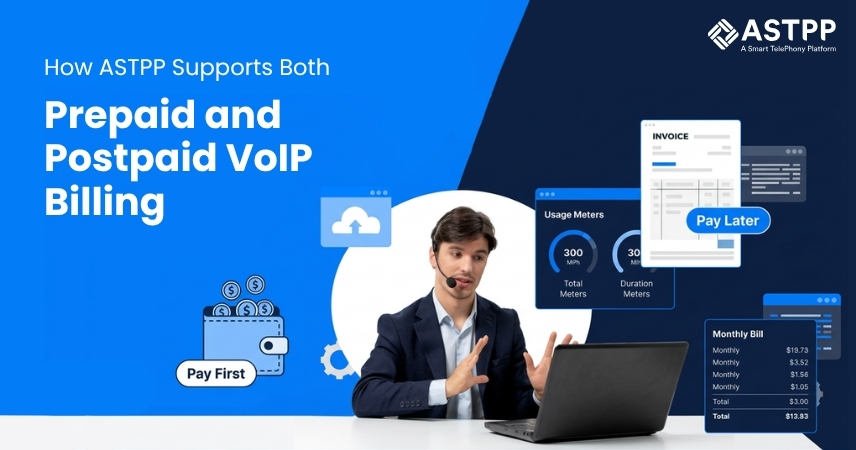
ASTPP’s online charging system VoIP architecture supports both prepaid and postpaid billing within a single platform. This eliminates the need for separate billing systems, reducing maintenance effort and preventing reconciliation issues between prepaid and postpaid CDR data.
For Prepaid Operations
- Nibble billing engine deducts balances incrementally during active calls rather than waiting until call completion, helping prevent overuse when balances are low.
- Auto-recharge via Stripe integration automatically tops up accounts when balances fall below a predefined threshold, minimizing service interruptions.
- Free minutes management accurately separates bundled free minutes from billable minutes without rounding errors.
- Real-time fraud detection identifies unusual calling patterns early, helping protect customer balances and reduce fraud-related losses.
For Postpaid Operations
- Daily and monthly credit limits are enforced at the account level, helping control exposure and reduce financial risk.
- Configurable billing cycles allow operators to set weekly, monthly, or custom billing intervals for individual accounts or products.
- Prorated billing accurately calculates charges for services activated or terminated during a billing cycle, eliminating manual adjustments.
- Order-invoice synchronization ensures customer orders and billing cycles remain aligned, reducing discrepancies between subscribed services and generated invoices.
- Partial payment support gives enterprise customers greater payment flexibility while simplifying collections management.
By supporting both prepaid and postpaid VoIP billing in a single platform, ASTPP enables operators to serve multiple customer segments, manage risk effectively, and streamline billing operations without maintaining separate systems.
For Mixed-Model Operations
ASTPP’s multi-tenant architecture supports both prepaid and postpaid billing across different levels of the reseller hierarchy. This allows operators to apply the billing model that best fits each customer segment without managing separate platforms.
For example, a telecom billing system operator can offer postpaid billing to enterprise resellers, while those resellers provide prepaid services to their retail end users.
All CDR data is consolidated into a single reporting layer, providing complete visibility across prepaid and postpaid operations. This unified approach simplifies management, improves reporting accuracy, and enables operators to scale efficiently across multiple customer types.
Common Mistakes Operators Make When Choosing a Billing Model
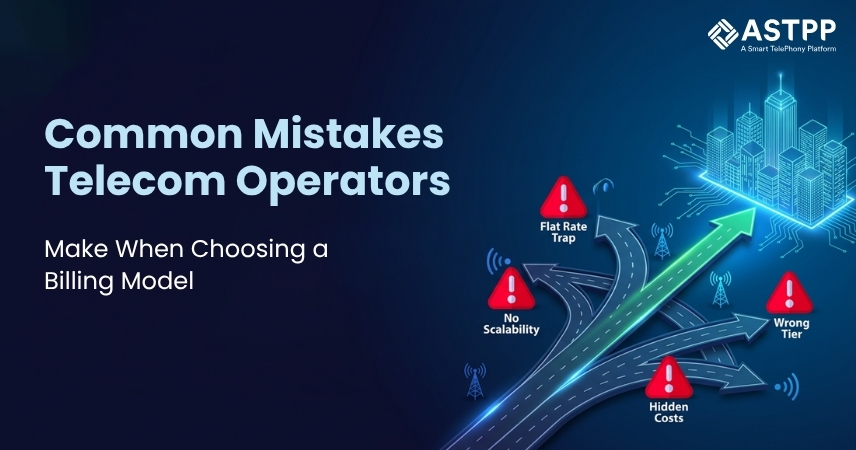
When selecting between prepaid and postpaid VoIP billing, operators often make decisions that create unnecessary financial and operational challenges later.
Common Pitfalls to Avoid
- Choosing postpaid billing because it appears more enterprise-focused, only to face growing bad debt from wholesale accounts that do not qualify for credit.
- Running a prepaid-only platform and later struggling to secure enterprise contracts because postpaid billing is not supported without significant system changes.
- Treating credit limits as a one-time setup rather than actively adjusting them based on customer usage patterns and risk profiles.
- Using a billing platform that supports one billing model natively and the other as an add-on, leading to CDR reconciliation issues when customers move between prepaid and postpaid accounts.
- Failing to configure daily credit limits on postpaid accounts, increasing the risk of substantial fraud losses from a single compromised account.
The most successful operators view billing models as part of their overall risk management strategy, not just a billing configuration. A platform that supports both prepaid and postpaid billing natively provides the flexibility to adapt as customer needs and business models evolve.
Getting the Billing Architecture Right from Day One
Choosing between prepaid vs postpaid VoIP billing is not a one-time decision. As your VoIP business grows, customer requirements evolve, and the billing model that works today may not be enough tomorrow. That is why operators need a VoIP billing software platform that supports both billing models natively. A flexible platform should provide seamless switching between prepaid and postpaid accounts, complete CDR visibility, and built-in fraud controls without requiring additional systems or custom integrations.
In practice, most established VoIP operators eventually use both models. Prepaid billing helps manage risk and cash flow, while postpaid billing supports enterprise customers, long-term contracts, and larger revenue opportunities. The challenge is ensuring your billing architecture can support both from the start.
ASTPP is designed to support prepaid and postpaid VoIP billing within a single carrier-grade platform. It includes an online charging system (OCS) for real-time prepaid balance management, along with full postpaid invoice lifecycle management covering usage tracking, invoice generation, and payment reconciliation.
The platform also provides unified CDR reporting and analytics across all customer types, built-in credit control and fraud management tools, and a multi-tenant architecture suitable for operators, resellers, and enterprise deployments.
Whether you are launching a wholesale termination business, growing a multi-tenant ITSP, or migrating from a legacy billing system, ASTPP delivers the flexibility to support your operations today and as they scale in the future.
Ready to Build the Right Billing Architecture for Your VoIP Business?
Talk to our team. We will walk you through how ASTPP’s prepaid and postpaid capabilities map to your current operation and where the platform can eliminate the gaps your existing system leaves open.


