 Introducing iCallify Built by ASTPP’s Engineering Team to Power Modern Contact Centers
Quick Summary: VoIP providers face billing challenges such as revenue leakage, inaccurate rating, complex invoicing, delayed charging, and growing operational demands. This guide explores the key VoIP billing challenges in 2026 and explains how ASTPP helps businesses improve accuracy, automation, control, scalability, and profitability.
Every VoIP operator engaged in legitimate business in 2026 is dealing with the same challenges: lower profit margins, higher traffic, and billing errors that now cost thousands instead of hundreds. Systems that worked for 500 customers often break down when the business grows to 5,000 customers.
According to a data, the global mobile VoIP market was worth USD 44.99 billion in 2023 and is expected to grow by 12.9% each year from 2024 to 2030. More growth also means more traffic, more complexity, and tougher competition. To keep up, operators need VoIP billing software that can scale without losing revenue.
This blog explains the six biggest billing and routing challenges telecom operators face in 2026 and how ASTPP helps solve them.
6 Key Billing and Routing Challenges Telecom Operators Face In 2026
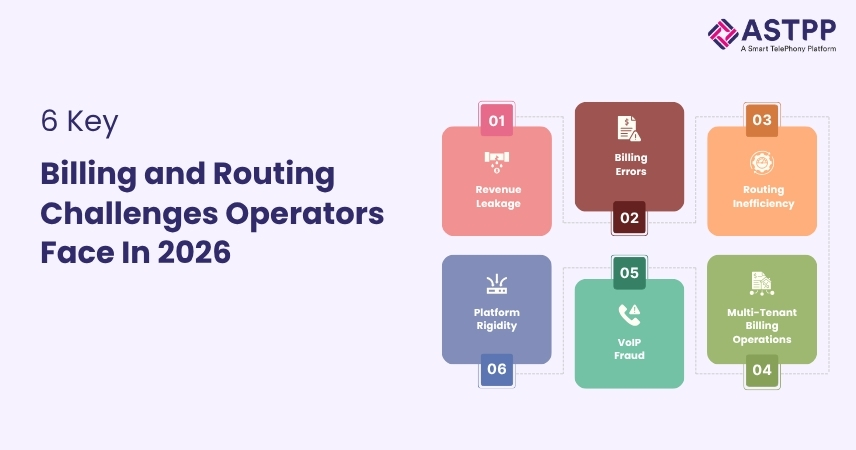
1. Revenue Leakage: The Hidden Profit Loss
Revenue leakage has always been a challenge in telecom, and it becomes even harder to control as call volumes grow. Small issues like incorrect rate tables, missed call records, or billing delays can quietly cause major financial losses over time.
According to TM Forum, telecom operators lose around 1% to 3% of their annual revenue because of revenue leakage. For a business handling $10 million in yearly traffic, that could mean losing up to $300,000 without noticing it immediately.
Common causes include:
- Calls that are never billed because of CDR processing errors.
- Differences between customer rates and carrier charges.
- Prepaid balances not updating in real time.
- Missing or duplicate call records during high traffic periods.
How ASTPP helps:
ASTPP uses real-time VoIP billing system to process call records as soon as a call ends. Its Online Charging System (OCS) updates prepaid balances instantly, ensuring every call is charged correctly. The platform also detects unusual or mismatched CDR records automatically, helping operators spot and fix billing issues quickly.
Also Read: VoIP Billing Software: Top Tips to Choose the Best Software
2. Billing Errors in High-Volume Operations
Improving VoIP billing accuracy at scale is one of the biggest challenges for telecom operators. When businesses handle thousands of calls every day across different carriers, pricing plans, and customer types, manual processes become difficult to manage.
Common billing issues include:
- Carrier rate tables updated incorrectly or inconsistently.
- Billing cycles missing data because of timing problems.
- Wrong rate groups applied to customers.
- Reseller invoices not matching actual customer usage.
Most telecom billing errors are caused by manual rate updates and configuration mistakes. As operations grow, automation becomes essential.
How ASTPP helps:
ASTPP automates rate management with unlimited rate groups and scheduled updates, so carrier pricing changes happen automatically. Operators can also test rates before they go live using rate simulators. Its CDR reporting tools compare billed call duration with actual call duration, making it easier to track and verify billing accuracy.
3. Routing Inefficiency and Shrinking Margins
Telecom operators lose money when routing is not optimized properly. Many carriers know they should improve routing, but without the right tools in their VoIP softswitch billing system, it often gets delayed.
Common routing problems in 2026 include:
- Static routing tables that don’t adjust to carrier quality changes.
- No backup routing when a carrier fails or quality drops.
- Call costs not balanced with quality metrics like ASR and ACD.
- No time-based routing to take advantage of lower carrier rates.
Operators that do not use active Least Cost Routing (LCR) often end up paying higher termination costs than those with optimized routing strategies. For wholesale VoIP providers handling large call volumes, inefficient routing can quickly reduce profit margins.
How ASTPP helps:
ASTPP’s routing engine supports Least Cost Routing (LCR), quality-based routing using live ASR metrics, percentage-based load distribution, time-of-day routing, CLI and non-CLI routing differentiation, and lossless failover. Once routing rules are configured, the system manages call routing automatically to reduce costs and improve call quality.
4. Scaling Multi-Tenant Billing Operations
Many telecom operators start with a small customer base but later expand into reseller networks or white-label VoIP services. This is where most scalable telecom billing software falls apart. Platforms designed for simple customer structures often cannot handle multiple reseller levels efficiently.
Common multi-tenant billing challenges include:
- No built-in support for different reseller models.
- Resellers forced to use the admin’s payment gateway.
- No separate rate management for each reseller.
- Commission tracking handled manually outside the system.
- Limited or no white-label branding options.
As the cloud PBX market continues to grow, operators need billing platforms that can support reseller management at scale.
How ASTPP helps:
ASTPP supports complete multi-tenant and reseller management from a single platform. Operators can create reseller hierarchies, assign separate payment gateways, manage reseller-specific rates and markups, automate commission tracking, and provide white-label branding at every level. This makes it easier to scale wholesale and reseller VoIP businesses efficiently.
5. VoIP Fraud: A Growing Revenue Risk
VoIP fraud remains a serious and growing challenge for the telecom industry. It continues to cause significant financial losses for operators worldwide, with attack methods becoming more advanced over time. Common threats include SIM swapping, International Revenue Share Fraud (IRSF), and unauthorized trunk access.
Typical gaps in fraud prevention include:
- No real-time alerts for unusual call patterns.
- Fixed fraud rules that are not updated regularly.
- No automatic blocking of suspicious activity during calls.
- Limited visibility into account-level call behavior.
How ASTPP helps:
ASTPP provides built-in fraud detection with configurable rules, real-time alerts, and automatic blocking actions. Its SIP fraud and IP security modules help stop attacks at the network level before billing happens. Features like Access Control Lists (ACLs), Do Not Call (DNC) rules, and per-account call restrictions give operators better control over traffic and reduce fraud risk.
6. Platform Rigidity and Vendor Lock-In
The VoIP billing market has no shortage of proprietary SaaS platforms. While they may work well at first, operators often run into limitations as their business grows. Customizations get expensive, API access is limited, and switching costs keep them locked in even when the platform stops meeting their needs.
Common issues with closed platforms include:
- Limited ability to customize billing logic.
- Restricted or paid API access.
- Deployment only on vendor-controlled infrastructure.
- Slow response to feature requests.
- Increasing licensing costs as usage grows.
How ASTPP helps:
ASTPP is an open-source VoIP billing platform that gives operators full control over the system. It can be deployed in cloud, on-premises, or high-availability setups, and customized to match different business models. The REST API layer supports integrations with Zoho, WHMCS, vtiger, Salesforce, Stripe, and more. There is no vendor lock-in because the platform belongs to the operator.

📘How PBXme Overcame VoIP Billing Challenges
Explore how ASTPP helped PBXme address billing complexity, improve automation, and scale efficiently.
Inside this Case Study:
- Automated billing workflows
- Reduced operational challenges
- Improved scalability and control
The Platform Behind Your Revenue
Most VoIP operators deal with the same issues: billing mistakes that add up, routing based on guesswork, fraud that is detected too late, and systems that don’t scale as the business grows. These problems are not unavoidable; they usually come from weak underlying infrastructure.
A carrier-grade VoIP billing platform should do more than just handle invoices. It should protect revenue with real-time charging, optimize routing using live network data, support scalable reseller structures, and give clear visibility into revenue and losses.
ASTPP is used by operators in many countries because it is built for real telecom operations. It combines billing, routing, and charging in one platform and can be deployed on infrastructure fully controlled by the operator.
If these challenges sound familiar, it may be worth exploring a more robust setup for your VoIP business.
Ready to build a billing operation that protects your margins at scale?


