 Meet ASTPP at Africa Tech Festival 2026 in Cape Town!

Quick Summary: ASTPP v7 introduces enhanced capabilities designed to help telecom operators improve billing, automation, management, and operational efficiency. This guide explores the latest features and improvements, showing how they support scalable telecom operations, streamlined workflows, greater control, and stronger business performance.
If you run a VoIP business, the economics are familiar. Carrier rates fluctuate, regulatory requirements multiply, and customers demand additional services as margins become tighter. It is not a matter of whether your system must adapt to these pressures; it is whether it can.
This ASTPP v7 / VoIP softswitch platform update represents a major step forward in a carrier-grade VoIP billing platform designed for modern telecom operations.
ASTPP version 7 features address this directly. Trusted by 20,000+ telecom operators across 95+ countries, this release delivers a full telecom billing software upgrade with 21 major enhancements across revenue, operations, compliance, and infrastructure. It strengthens ASTPP as both a VoIP softswitch billing system and a flexible BSS OCS telecom platform for service providers.
This article covers all major ASTPP version 7 features, focusing on real operator use cases.
If you prefer a walkthrough, the ASTPP v7 launch webinar recording demonstrates these capabilities in action.
1. New Revenue Streams: Monetize Beyond Voice Calls
Most operators already have voice billing covered. The real missed revenue is in related services customers already expect, but legacy platforms cannot deliver without separate integrations. ASTPP v7 introduces VoIP billing platform new features 2026 that unlock these opportunities directly inside the platform.
As a real-time VoIP billing system, ASTPP v7 allows operators to monetize services instantly without external billing layers.
SMS Billing and Delivery
ASTPP v7 includes built-in SMS billing with no need for third-party middleware. Operators can manage both SMS and voice through a unified telecom billing system features stack with consolidated billing and reporting.
What operators can configure:
- SMS origination and termination rates, managed exactly like voice tariffs.
- Free or paid SMS bundles, offered on a one-time or recurring basis.
- Combined voice and SMS invoices in a single billing view.
- Nexmo gateway support by default, with the option to add custom third-party SMS gateways.
- Inbound and outbound usage reporting per customer.
According to a report, the global business messaging traffic will grow from 1.9 trillion messages in 2023 to 2.8 trillion by 2027.
For operators running retail VoIP or SIP trunking services, SMS bundling directly increases average revenue per user without adding infrastructure cost.
Surge Charge: Time and Date Based Surcharges
During peak traffic periods, operators face higher carrier costs while billing rates remain unchanged, reducing margins. Surge Charge fixes this by automatically adjusting rates based on the time, day, or date.
Examples of surcharge rules operators can create:
- Weekend Boost: +10% from Friday to Sunday, 10 AM to 10 PM
- Holiday Premium: +25% on selected public holidays
- Peak Hour Rates: Custom surcharges for specific rate groups
This improves profitability within a VoIP softswitch billing system by aligning pricing with real-time traffic conditions.
Vanity Number Support
Enterprise customers and BPOs often need branded phone numbers like 1-800-COMPANY. Previously, this required separate DID workflows or manual setup. With ASTPP v7, vanity number support is built directly into DID management.
How it works:
- Enable vanity number detection in settings
- The system automatically matches the vanity number to the correct DID
- Calls route through the existing DID system with no extra provisioning needed
This simplifies operations inside a BSS OCS telecom platform, especially for marketing-heavy or toll-free services.
Auto Dialer with AMD Detection
Key features include:
- Campaign Management: Create and schedule outbound (marketing, collections, and reminder) campaigns.
- Lead Management: Upload and manage contact lists or targeted outbound calling.
- AMD Detection: Detect live answers vs voicemail automatically to reduce wasted calls.
- Flexible Routing: Route answered calls to Audio, SIP, Queue, IVR, Ring Group, or IP.
- Scheduling Controls: Set start and end times, retry intervals, and call limits per campaign.
- Live Monitoring: Track campaign performance and results in real time.
2. Operational Efficiency: Less Manual Work, Fewer Billing Errors
Billing accuracy is critical in any telecom billing system features implementation. Any manual rate changes that fail to touch certain accounts, any manually generated reports, and every origination rate change without an audit trail creates real operational risk. ASTPP v7 addresses each of these directly.
Rate Templates for Bulk Rate Management
For operators managing dozens or hundreds of customer accounts, maintaining rate consistency has historically meant repetitive data entry. Altering the carrier rate means that they would have to change it for every account. This is no longer the case with ASTPP v7 because of Rate Templates.
Before and after Rate Templates
- Without Rate Templates: Configure rates manually for every customer. One rate change means updating every account individually.
- With Rate Templates: Update the template once. All accounts assigned to that template reflect the change automatically.
For wholesale operators managing large account bases, this is a key upgrade in modern telecom billing software upgrade cycles. It directly reduces the risk of billing inconsistencies and the manual workload of rate administration.
Origination Rate History and Audit Trail
Rate disputes are common in VoIP operations. Without a clear history of rate changes, resolving them can be slow and costly. ASTPP v7 now keeps a complete audit trail of origination rate changes for every destination.
Why this matters for operators:
- Quickly verify disputed rate changes with timestamped records
- Access built-in pricing history for regulatory audits
- Easily track how rate changes impact revenue over time
People Also Read: Telecom Billing for Wholesale VoIP: Best Practices You Should Know
Automated Scheduled Report Delivery
Do you know? The global telecom industry loses more than $30 billion each year to revenue leakage, driven not by fewer subscribers or competition, but by billing errors and fragmented systems.
Operations teams spend hours every month pulling CDR summaries, usage reports, and billing reconciliation data by hand. ASTPP v7 lets operators automatically generate and send reports, removing the need for manual work.
3. Security, Compliance and Control
Regulatory requirements for telecom operators have been increasing over time. KYC requirements for DID provisioning, call list compliance obligations, and identity management for platform access are now essential. ASTPP v7 strengthens its role as an open-source VoIP billing platform update with built-in regulatory tools.
Single Sign-On with Google and Microsoft
Platform administrators can now log in using Google or Microsoft SSO instead of separate ASTPP credentials. For operators running multi-staff operations or working with IT teams that enforce enterprise identity policies, this simplifies access management.
KYC Country-Specific DID Verification
Regulatory requirements for DID provisioning vary by country. In some markets, assigning a phone number without identity verification creates direct compliance liability. ASTPP v7 introduces KYC verification that is configured per country, requiring customers to complete the relevant identity check before purchasing or being assigned a DID.
What this solves:
- Operators in regulated markets can enforce KYC without building custom compliance workflows.
- Country-level configuration means verification requirements apply only where needed.
- Reduces the risk of unauthorized DID assignment in markets where verification is mandatory.
Do Not Call List Management and Allow/Deny by Prefix
ASTPP v7 adds built-in tools for call compliance and routing control.
- Do Not Call (DNC) list management lets operators block numbers directly in the platform.
- Allow/Deny list by prefix lets admins control which destination codes each account can call.
For BPOs and wholesale carriers, these features reduce the need for external tools or manual checks to enforce compliance.
DID Provider Trunk Enforcement
This feature from v7.0.2 gives administrators the ability to force outbound DID calls through a specific provider trunk. For operators managing multiple carrier relationships and routing cost structures, trunk enforcement provides robust control over routing decisions and the costs that follow from them.
4. Platform Upgrades: Performance, UI, and Infrastructure
Beyond business features, this ASTPP v7 / VoIP softswitch platform update also includes major infrastructure improvements that improve stability, security, and performance for production environments.
PHP 8.2 and Framework Security Updates
ASTPP v7 upgrades the underlying PHP runtime to version 8.2 and updates core frameworks for security. PHP 7.4 is no longer supported, meaning operators still running v6 on older PHP versions were carrying security debt. v7 closes that gap while also delivering the performance improvements that come with a modern runtime.
Light and Dark Theme Support
Operations teams spending long hours in the admin console will find this genuinely useful. ASTPP v7 adds full light and dark mode support across the interface. For NOC teams and overnight operations staff, dark mode significantly reduces eye strain during extended platform sessions.
New Dashboards
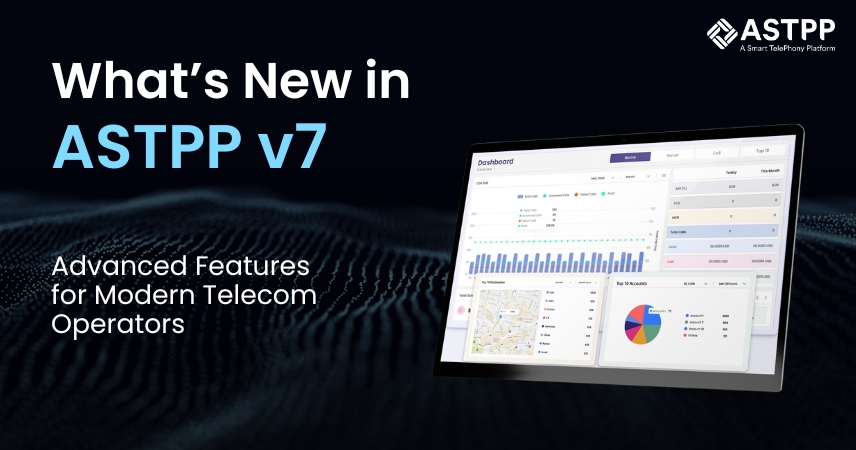
Redesigned dashboards in v7 improve visibility into platform health and traffic metrics. Operators get better real-time summaries without having to drill into individual report sections for routine monitoring.
Additional Improvements in v7.0.2
The v7.0.2 patch release, issued in April 2026, delivered 9 additional new features, 12 improvements, and 42 bug fixes on top of the v7 foundation. Key additions include:
- Automatic CLI Assignment: Auto-assign Caller Line Identification based on rules, reducing manual configuration overhead.
- Non-CLI Rating: Apply separate billing logic for calls without a valid CLI, giving operators accurate revenue capture regardless of caller identification status.
- SIP Device Limit per Account: Set a maximum number of SIP devices per account and define a default SIP profile, enforcing account policies out of the box.
- Multiple Click-to-Call Tokens: Each customer account can now hold multiple click-to-call tokens, enabling separate integrations with per-token configuration.
- Dynamic Session Timeout Configuration: Administrators can configure session timeout values from the settings panel rather than relying on hardcoded values.
Real Operator Use Cases
Here’s how different types of operators use v7 features in practice:
1. Wholesale VoIP Carrier
A wholesale carrier managing 200+ reseller accounts uses Rate Templates to push carrier rate updates across the entire account base in minutes rather than hours. Origination Rate History gives the billing team a documented record for every account when disputes arise. Automated report delivery eliminates the monthly manual reconciliation cycle.
2. ITSP Serving BPO Clients
An ITSP with BPO clients uses the Auto Dialer to offer outbound campaign services as a billable add-on. DNC list management keeps the operation compliant with client call restrictions. SMS Billing lets the operator bundle text-based appointment reminders with existing voice packages, adding ARPU without additional infrastructure cost.
3. SIP Trunking Provider in a Regulated Market
A SIP trunking provider operating across multiple countries with varying DID regulations uses country-specific KYC to enforce identity verification only where required. DID Provider Trunk Enforcement give the routing team precise control over which provider handles specific number ranges, protecting margins on regulated traffic.
What Is Coming in ASTPP v7.1
Here’s what’s planned for the next release:
New Features in Development:
- IP Security Module for tighter access control at the network layer.
- MNP (Mobile Number Portability) Lookup integration.
- Optional X-Header parameter for IP Authentication in SIP requests.
- SIP CIDR support for IP-range-based routing and authentication.
- Auto-import for termination rates, removing manual rate file uploads.
Performance Improvements Planned:
- Real-time data table updates via inline editor on edit pages.
- Database optimization and performance tuning.
- Lua routing code performance optimization.
People Also Read : Beginner’s Guide to SIP Trunking Start Your VoIP Journey
Conclusion:
ASTPP v7 is a major step forward in ASTPP version 7 features, combining revenue generation, automation, and compliance in a unified system. It evolves beyond a traditional billing tool into a complete VoIP softswitch billing system and BSS OCS telecom platform.
This ASTPP v7 / VoIP softswitch platform update ultimately strengthens both revenue potential and operational control.
Whether you are evaluating a telecom billing software upgrade, migrating from legacy systems, or comparing alternatives like PortaOne or Kolmisoft, ASTPP v7 demonstrates how an open-source VoIP billing platform update can deliver both flexibility and carrier-grade depth.
Ready to see ASTPP v7 in action for your operations?


