 ASTPP v7.3 Launch Webinar – Join Us on Sept 30, 2026
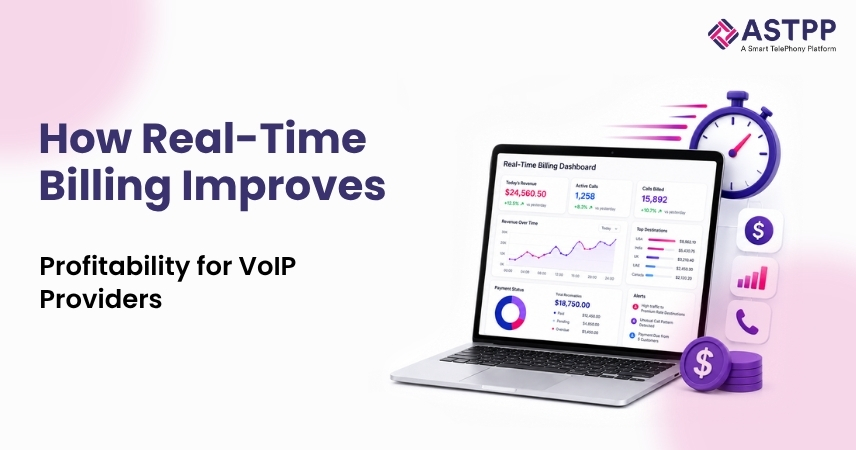
Quick Summary: Real-time billing helps VoIP providers improve profitability through accurate call charging, real-time usage tracking, optimized routing, and automated prepaid billing. By reducing billing errors and revenue leakage, providers can strengthen financial control, improve operational efficiency, and maximize revenue with a reliable VoIP billing solution.
Most VoIP providers do not lose money from one big mistake. They lose it little by little, one call at a time, when billing falls behind the network. A call may finish on already-used credit, a rate change may be applied late, or fraud may go unnoticed for an hour. Batch billing finds these issues after the revenue is lost, while real-time billing catches them as they happen. That is why a real-time VoIP billing system is important. VoIP billing profitability depends on using VoIP billing software that rates and charges every call the moment it ends.
What Real-time Billing Means for a VoIP Provider

Real-time billing rates and charges a call as it happens instead of waiting for an overnight or end-of-cycle batch. Every call creates a Call Detail Record (CDR) at the start and end, and a real-time VoIP billing software processes it immediately instead of placing it in a queue.
For prepaid calls, an Online Charging System (OCS) checks the customer’s balance before the call connects, reserves enough credit for the expected call duration, and charges the exact amount when the call ends.
During every call, the system performs four key tasks in real time:
- Authorizes the call against the customer’s balance or credit limit before it connects.
- Rates the call using the correct rate deck and destination when it ends.
- Creates an accurate CDR for both finance teams and customers.
- Updates balances and margin data instantly for the next billing decision.
Keeping ratings and balances up to date helps providers make better pricing, routing, and risk decisions immediately instead of finding and fixing revenue losses later.
People Also Read: How Real-Time Billing Helps Telecom Businesses Prevent Revenue Leakage
The Profitability Problem with Delayed Billing

Delayed billing creates hidden costs that build up over time. Instead of one large loss, VoIP providers lose revenue through small billing errors that add up across thousands or millions of calls.
Studies show how significant this problem can be. An analysis estimates telecom revenue leakage at around 1% to 5% of annual revenue, while a report, found that some operators fail to collect about 7% of the revenue they are owed. Fraud adds even more pressure, with the Communications Fraud Control Association (CFCA) estimating global telecom fraud losses at 39.89 billion dollars in 2022.
For a VoIP provider, the most common causes of revenue loss are:
- Calls that continue after a prepaid balance is exhausted.
- Rate changes applied late, causing calls to be billed at outdated rates.
- CDR gaps and rating errors that lead to under-billing.
- Fraudulent or looping traffic that continues until a batch job detects it.
- Customer disputes caused by billing mistakes.
Each issue may seem small on its own, but together they can significantly reduce profit margins. High VoIP billing accuracy depends on VoIP billing software that processes calls in real time and keeps billing aligned with network traffic.
How Real-time Billing Improves VoIP Billing Profitability

Real-time billing improves VoIP billing profitability by ensuring every call is billed accurately and immediately. Instead of waiting for batch processing, providers can protect revenue, reduce risk, and make better operational decisions as calls happen.
- Prepaid Revenue Is Protected: An Online Charging System (OCS) verifies the customer’s balance before the call connects, reserves the required credit, and settles the exact charge when the call ends. This prevents customers from using more credit than they have and reduces revenue loss from overspending.
- Margins Stay Protected: When billing and Least Cost Routing (LCR) work together, calls are routed using the most cost-effective path while being billed with the correct rates. This keeps routing decisions and billing aligned, helping providers maintain consistent margins on every call.
- Cash Flow Improves: Since CDRs are processed in real time, invoices are generated from accurate billing records without waiting for lengthy reconciliation. This helps providers bill customers faster and recognise revenue sooner.
- Costs Are Easier to Control: Real-time billing gives providers instant visibility into call usage, balances, and revenue. Billing errors, unusual traffic patterns, and potential fraud can be identified quickly, reducing revenue leakage and improving operational efficiency.
Ultimately, VoIP billing software that supports real-time billing helps providers capture all the revenue they earn, improve VoIP billing accuracy, and build stronger long-term profitability.
A profitable VoIP billing setup depends on multiple features working together in real time. The goal is not just to bill calls, but to ensure every call is authorised, rated, and charged accurately while reducing manual work and revenue loss.
The Capabilities That Drive the Numbers
A profitable VoIP billing setup depends on multiple features working together in real time. The goal is not just to bill calls, but to ensure every call is authorised, rated, and charged accurately while reducing manual work and revenue loss.
Key capabilities include:
- An Online Charging System (OCS) that authorises calls, reserves prepaid credit and settles the final charge when the call ends.
- Real-time CDR processing and call rating, with re-rating to update historical billing when rates change.
- Integrated Least Cost Routing (LCR) so routing and billing use the same rate data, keeping costs and charges aligned.
- Real-time fraud detection that identifies and responds to suspicious traffic as it occurs.
- Multi-tenant and multi-level reseller billing that allows service providers to manage multiple customers and resellers from a single platform.
- Automated invoicing and rate imports to reduce manual tasks and improve billing efficiency.
Together, these capabilities help improve VoIP billing accuracy, reduce revenue leakage, and support better telecom revenue optimization. The key difference is whether your VoIP billing software makes charging decisions in real time or only after the call has already been completed.
People Also Read: How to Choose the Right VoIP Billing Platform in 2026
How ASTPP Delivers This

ASTPP is a carrier-grade VoIP billing and softswitch platform designed specifically for telecom operators. It supports real-time billing for prepaid, postpaid, and hybrid services, helping providers rate and charge every call as it happens.
Its built-in Online Charging System (OCS) verifies prepaid balances and credit limits before calls connect, while the integrated Least Cost Routing (LCR) engine ensures routing decisions and billing use the same rate data. CDRs are processed in real time, and re-rating allows providers to update historical billing records when rate plans change.
ASTPP also offers:
- Real-time billing for prepaid, postpaid, and hybrid services.
- OCS for balance checks, credit control, and prepaid charging.
- Integrated LCR with a shared billing and routing engine.
- Real-time CDR processing and re-rating.
- Multi-tenant and multi-level reseller billing.
- Flexible deployment in cloud, on-premises, or high-availability environments.
- An open-source, customisable platform that adapts to different business models.
By combining these capabilities, ASTPP helps telecom operators improve VoIP billing accuracy, reduce revenue leakage, and increase VoIP billing profitability without adding unnecessary complexity.
What This Looks Like in Practice
Here are a few examples of how real-time billing improves day-to-day operations for different VoIP providers:
- A wholesale carrier rates every call as it ends, ensuring billing stays aligned with Least Cost Routing (LCR) and protecting margins on high-volume traffic.
- A prepaid ITSP uses an Online Charging System (OCS) to verify customer balances before calls connect, preventing overspending and reducing revenue loss.
- A reseller-based provider gives each reseller a branded billing portal while maintaining central control over billing, reporting, and profitability across the network.
Conclusion:
For VoIP providers, profitability depends on charging every call accurately and at the right time. Real-time billing helps operators authorise calls, apply the correct rates, and protect revenue as traffic flows instead of finding billing issues after the fact.


