 Introducing iCallify Built by ASTPP’s Engineering Team to Power Modern Contact Centers
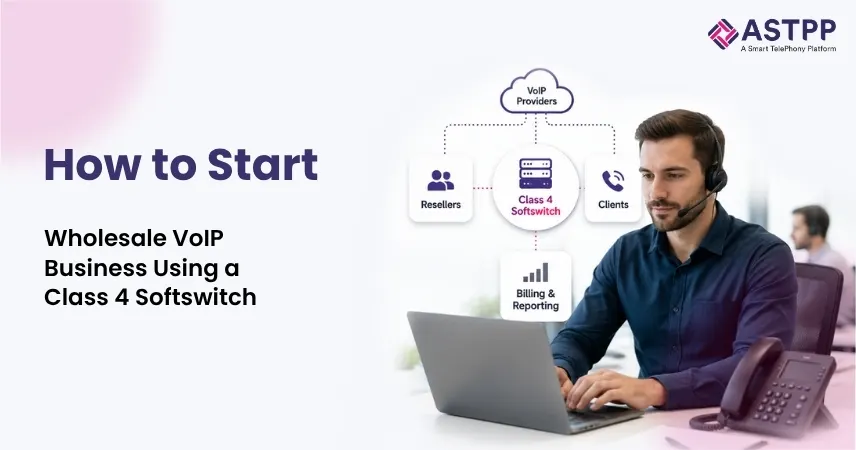
Quick Summary: Starting a wholesale VoIP business with a Class 4 softswitch requires reliable routing, carrier management, billing, and traffic control. This guide explains components, operational considerations, and benefits of using a modern Class 4 softswitch to build and scale a business.
The VoIP market continues to grow, creating new opportunities for businesses entering the wholesale space. However, success depends on building a profitable and scalable operation from the beginning.
For a wholesale VoIP business, three areas matter most:
- Switching infrastructure to handle voice traffic reliably.
- Routing strategy to manage call quality and costs.
- Billing platform to track usage and maintain profitability.
A strong foundation in these areas helps businesses scale efficiently. This guide covers the key steps to launch a VoIP business, set up a Class 4 softswitch, and prepare the infrastructure needed to handle carrier-level traffic.
What Is a Class 4 Softswitch?
A Class 4 softswitch is a core component of a wholesale VoIP business. It manages high-volume voice traffic between carrier networks by receiving calls from originating carriers and routing them to termination providers based on factors like cost, quality, and availability.
Unlike a Class 5 softswitch, which focuses on end-user features such as voicemail, IVR, call forwarding, and conference calling, a Class 4 softswitch operates at the carrier level and manages large-scale trunk-to-trunk connections.
For wholesale VoIP providers, Class 4 softswitch capabilities are essential for handling high call volumes, flexible routing, and carrier interconnects. Starting with only a Class 5 platform can create scalability challenges later, as carrier-level operations require different infrastructure, routing, and capacity planning.
Why the Wholesale VoIP Business Model Works

The foundation of a wholesale VoIP business is Least Cost Routing (LCR). Providers purchase termination capacity from multiple carriers and route calls through the most cost-effective option while maintaining required quality standards.
At scale, even small improvements in routing efficiency can significantly impact profit margins. A reliable Class 4 softswitch and wholesale VoIP billing platform help automate routing, usage tracking, and billing operations.
The wholesale model is also designed for scalability. Instead of managing thousands of individual users, operators focus on carrier relationships, traffic management, and optimized routing strategies. With the right infrastructure, a wholesale VoIP carrier can grow efficiently while maintaining control over costs and service quality.
Core Infrastructure for a Wholesale VoIP Business

A successful wholesale VoIP business depends on three key components: a reliable Class 4 softswitch, a powerful VoIP billing software, and strong carrier relationships.
1. Class 4 Softswitch
The Class 4 softswitch is the core routing and switching layer. It manages high-volume voice traffic and must handle concurrent calls while maintaining call quality. Many production deployments use dedicated servers and high-availability setups to ensure reliable performance.
2. Wholesale VoIP Billing Platform
A reliable wholesale VoIP billing platform is essential for managing carrier-level operations. It handles real-time billing, usage tracking, rating, and invoicing.
Key capabilities include:
- Real-time prepaid and postpaid billing with accurate call rating.
- CDR processing for tracking call duration, destinations, and carrier usage.
- Integrated LCR engine for optimized routing decisions.
- Multi-carrier rate management and bulk rate updates.
- Multi-tenant and reseller billing support.
- Automated invoicing, balance tracking, and low-balance alerts.
- Fraud detection with configurable limits and blocking rules.
A billing system designed for small-scale operations may not support the complexity of wholesale traffic, making scalability an important consideration.
3. Carrier Relationships
Strong carrier partnerships directly impact your margins and service quality. Most wholesale VoIP carriers work with multiple termination providers for each destination to improve redundancy, maintain call quality, and enable effective Least Cost Routing (LCR).
Building the right combination of infrastructure and carrier relationships creates a strong foundation for long-term wholesale VoIP growth.
How to Launch SIP Trunking and Wholesale VoIP Services: Step by Step

Launching a wholesale VoIP carrier platform requires a structured approach. Each stage builds on the previous one, so proper planning is essential.
Step 1: Define Your Target Market and Routes
Start with a focused market instead of trying to cover every destination at once. Build strong carrier relationships for the routes your customers need most, then expand gradually.
Step 2: Choose and Deploy Your Class 4 Softswitch
Deploy a Class 4 softswitch based on your expected call volume and future growth plans. Capacity depends on factors like codecs, transcoding, and media handling. As traffic grows, consider moving to a high-availability setup to maintain reliability.
Step 3: Configure Routing and Connect Carriers
A proper Class 4 softswitch setup includes:
- SIP trunk configuration for carrier connections.
- Authentication settings based on carrier requirements.
- Route groups with priority rules for each destination.
- LCR (Least Cost Routing) rules based on cost and quality.
Step 4: Set Up Billing Before Customer Onboarding
A reliable wholesale VoIP billing platform should be configured before processing live traffic. Load rate decks, create tariff plans, and test CDR generation to ensure accurate billing before customers go live.
Step 5: Onboard Customers and Monitor Performance
Begin with a small customer group and validate routing, billing accuracy, and call performance. Continuous monitoring of call activity, trunk health, and account balances helps maintain reliable service as your wholesale VoIP business grows.
What a Good VoIP Platform for ITSPs Looks Like
A reliable VoIP platform for ITSPs and wholesale carriers needs more than just call routing. The right operational tools help providers manage traffic, improve efficiency, and respond quickly to issues.
A capable platform should provide:
- Live call monitoring with trunk visibility and real-time call insights.
- CDR reports organized by customer, destination, and carrier.
- Fraud detection with automatic alerts and blocking rules.
- Multi-level reseller support for expanding distribution networks.
- Rate simulator tools to test routing decisions before deployment.
- REST API access for connecting CRM systems, customer portals, and external billing solutions.
The right platform reduces manual operations and gives ITSPs better control over their growing VoIP business.
People Also Read: Top 10 VoIP Billing Software in 2026: Features, Pricing & Comparison
Common Mistakes When Launching a Wholesale VoIP Business

Many operators face challenges in their first year because of a few common mistakes:
- Underestimating billing complexity: Carrier-level operations require accurate real-time CDR processing. Billing errors can quickly lead to revenue loss.
- Insufficient carrier redundancy: Relying on a single carrier for important routes creates service risks. Multiple carrier options help maintain reliability.
- Delaying LCR optimization: Least Cost Routing (LCR) directly impacts margins. Optimizing routes early helps control costs and improve profitability.
- Choosing a platform that cannot scale: A telecom billing system for startups may not support future growth. Select a platform that can handle increasing traffic and operational complexity.
- Skipping fraud detection: Enable fraud monitoring and blocking rules from the beginning to prevent unexpected losses from suspicious traffic.
Building the right infrastructure early helps a wholesale VoIP business scale smoothly and avoid costly changes later.
How ASTPP Powers Wholesale VoIP Operators
ASTPP is a carrier-grade VoIP billing and softswitch platform designed for businesses running wholesale VoIP operations. It combines Class 4/Class 5 softswitch capabilities with a complete BSS and Online Charging System, helping operators manage routing, billing, and customer operations from a single platform.
Key advantages for operators include:
- Integrated LCR with the billing engine, allowing routing optimization and revenue management in one system.
- Real-time prepaid and postpaid billing with accurate CDR processing for large-scale operations.
- Multi-tenant and multi-level reseller billing with support for independent rate groups and customer management.
- Flexible deployment options including cloud, on-premises, and high-availability environments.
- Custom development capabilities for businesses that need features beyond standard configurations.
With its combination of switching, billing, and operational tools, ASTPP helps wholesale VoIP operators build scalable and efficient communication platforms.
Conclusion
A successful wholesale VoIP business depends on having the right infrastructure from the beginning. With optimized routing, accurate billing, and a scalable platform, operators can improve efficiency and support long-term growth.
Many challenges in wholesale VoIP come from platform limitations rather than market conditions. Choosing the right Class 4 softswitch and wholesale VoIP billing platform early helps businesses scale faster and avoid costly migrations later.


