 Introducing iCallify Built by ASTPP’s Engineering Team to Power Modern Contact Centers
Quick Summary: Real-time charging enables instant usage tracking, flexible pricing, and personalized offers, improving customer experience and revenue management. Traditional billing remains simpler and reliable for predictable services. Modern telecom providers can combine both approaches to balance agility, operational efficiency, accuracy, and customer expectations.
Every telecom operator eventually faces the same decision: charge customers as they use the service or bill them later at the end of a billing cycle. This is the difference between real-time charging and traditional billing, and it has a direct impact on revenue, cash flow, and customer experience.
Traditional billing processes usage in batches after calls, messages, or data sessions are completed. While this approach has been used for years, it creates a delay between service usage and billing, increasing the risk of billing errors, revenue leakage, and fraud.
Real-time charging works differently. It rates and charges calls, SMS, or data usage as it happens. An Online Charging System (OCS) checks available balance or credit before the session begins, applies the correct charges during the session, and updates the account immediately. This keeps billing accurate and reduces the gap between service usage and revenue collection.
For wholesale carriers, ITSPs, and SIP trunking providers operating on tight margins, choosing between these two models is more than a technical decision. It affects profitability, fraud prevention, cash flow, and customer trust.
In this article, we’ll compare real-time charging vs traditional billing, explain how each model works, highlight the limitations of batch billing, and explore how a modern OCS telecom platform helps operators improve billing accuracy while supporting business growth.
What Real-Time Charging and Traditional Billing Actually Mean
Traditional billing, also known as postpaid or batch billing, collects usage records, such as Call Detail Records (CDRs), throughout a billing cycle. At the end of the cycle, the system rates each record, applies taxes and other charges, and generates an invoice. Customers pay after the services have already been used.
Real-time charging works differently. Using an Online Charging System (OCS), the system authorises, rates, and charges usage as it happens. For prepaid customers, the available balance is checked before the session begins and updated immediately. For postpaid customers, the system can monitor credit limits in real time and prevent additional usage when the limit is reached.
The key difference between an Online Charging System (OCS) and postpaid billing is timing:
- Traditional billing: Service is used first, and billing happens later.
- Real-time charging: Usage is authorised and charged immediately, reducing financial risk.
This distinction is especially important when comparing prepaid vs postpaid telecom billing.
- Prepaid billing is typically used for prepaid subscribers, calling cards, and many wholesale services because payment is secured before or during service usage.
- Postpaid billing is commonly used for enterprise and contract customers who receive an invoice at the end of the billing cycle based on their agreed credit terms.
By charging usage as it occurs, real-time charging helps telecom operators improve billing accuracy, reduce revenue leakage, and maintain better control over customer balances and credit exposure.
Real-Time Charging vs Traditional Billing: The Core Differences
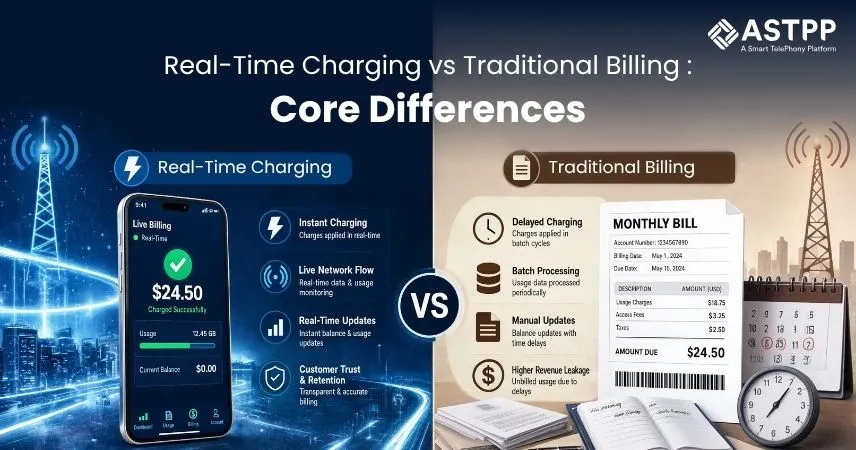
Although both billing models calculate service usage, they differ in how and when charges are applied.
| Feature | Real-Time Charging | Traditional Billing |
| Timing | Charges are applied during or immediately after the session. | Usage is collected and billed at the end of the billing cycle. |
| Fraud exposure | Can stop usage when a balance or credit limit is reached. | Fraud or excessive usage may continue until billing is processed. |
| Credit control | Enforces balance and credit limits in real time. | Credit checks and collections happen after usage. |
| Infrastructure | Requires a high-performance rating engine that processes requests instantly. | Uses batch processing, so immediate responses are not required. |
| Customer experience | Customers can view up-to-date balances and usage information. | Customers only see charges when the billing cycle ends. |
| Best suited for | Prepaid services, wholesale traffic, and high-risk accounts. | Enterprise customers and other accounts billed on fixed payment cycles. |
The right billing model depends on your business requirements. Real-time charging provides greater control over balances, credit, and revenue, making it ideal for prepaid and wholesale services. Traditional billing remains a practical option for customers with established payment terms and predictable usage patterns.
Industry Challenges with Traditional Billing Models
Traditional batch billing creates several challenges that become more difficult to manage as call volumes, customers, and routing complexity increase.
- Revenue leakage between usage and invoicing: Rating mistakes, missing records, or billing discrepancies are often discovered only after the billing cycle ends, making real-time correction difficult.
- Extended fraud exposure: Compromised accounts or suspicious traffic can continue generating costs until the next batch process identifies the issue.
- Limited margin visibility: Operators using Least Cost Routing (LCR) across multiple carriers may not see their actual margins until billing is completed, making real-time optimisation harder.
- Complex multi-tenant reconciliation: Resellers and sub-resellers often use different rate plans and billing rules, increasing the risk of pricing mismatches that are difficult to detect after the fact.
- Fixed billing cycles for continuous traffic: Wholesale VoIP traffic operates around the clock, but batch billing processes usage only at scheduled intervals, creating a gap between service delivery and revenue tracking.
For modern telecom operators, these limitations make real-time charging increasingly important. By processing usage instantly, operators gain better control over billing accuracy, fraud prevention, and profitability.
Business Impact of Moving to Real-Time Charging

Moving to real-time charging gives telecom operators better control over revenue, risk, and customer accounts by reducing the delay between usage and billing.
- Immediate margin visibility: Operators can track costs, revenue, and profitability per call instead of waiting until the billing cycle ends.
- Lower bad debt: Real-time credit checks, balance monitoring, and low-balance alerts help prevent customers from exceeding their limits and creating unpaid usage.
- Improved cash flow: Revenue collection moves closer to the point of usage, reducing delays caused by long billing and payment cycles.
- Faster fraud response: Suspicious traffic patterns can be detected and blocked immediately instead of being discovered after losses occur.
- Better reseller control: Multi-tenant operators can monitor reseller balances, usage, and margins in real time without waiting for batch processing.
The goal of telecom billing software is not to replace every postpaid customer with prepaid billing rules. It is about eliminating the gap between service usage and financial control, especially where that delay creates revenue risk. Real-time charging helps operators make faster decisions, protect margins, and improve overall billing efficiency.
Key Features of a Modern OCS Telecom Platform

A modern OCS telecom platform needs more than fast batch processing. For operators evaluating a real-time VoIP billing system, the focus should be on features that provide accurate charging, better control, and real-time visibility.
Key capabilities include:
- Real-time rating engine that calculates and deducts usage during the call instead of waiting until the session ends.
- Incremental (nibble) billing that charges usage in small intervals during an active session, improving accuracy and reducing credit risk.
- Prepaid and postpaid support on a single platform, allowing operators to manage different customer types without separate billing systems.
- Credit limit and low-balance controls that allow operators to set daily and monthly usage rules for each account.
- Free-minute and bundle management that applies included usage correctly while avoiding rating and rounding errors.
- Multi-tenant rate management that allows resellers to maintain their own pricing structures while keeping central control over billing logic.
- Integrated fraud detection connected directly with billing rules and usage thresholds to identify and prevent suspicious activity quickly.
When comparing carrier billing platforms, the key difference is not only whether a system can generate accurate invoices. Many platforms handle batch billing well, but fewer can deliver true real-time charging, balance control, and rating performance at carrier scale.
How ASTPP Solves This
ASTPP combines prepaid and postpaid billing on a single carrier-grade platform, allowing operators to support different customer models without managing separate billing systems.
Key capabilities include:
- Nibble Billing: Charges are deducted incrementally during an active call instead of only after the call ends, giving prepaid and wholesale customers accurate real-time balance control.
- Prepaid & Postpaid Billing: Supports real-time balance deduction for prepaid accounts and scheduled invoicing for postpaid customers using the same rating engine.
- Daily & Monthly Credit Limits: Allows operators to set account-level spending limits and automatically prevent excessive usage before it creates revenue risk.
- Free Minutes Handling: Automatically separates bundled minutes from standard-rated usage during a call, helping prevent rating errors and billing disputes.
- Multi-Tenant Billing Architecture: Enables resellers to manage their own customers, rate groups, and billing rules while the central OCS keeps balances and usage data updated.
- Automated Invoicing: Generates postpaid invoices on schedule for customers who require traditional billing cycles while maintaining real-time rating capabilities.
The result is a unified OCS telecom platform that supports everything from prepaid calling card traffic to enterprise postpaid services. Operators can manage multiple billing models on one system while improving VoIP billing accuracy, reducing revenue leakage, and maintaining real-time control over customer usage.
Real Business Use Cases
Real-time charging helps telecom operators improve control, reduce risk, and protect revenue across different business models.
- Wholesale VoIP provider protecting termination margins: A carrier handling high-volume traffic can use nibble billing to monitor balance usage during active calls and prevent unpaid usage from building up before the billing cycle ends.
- SIP trunking provider managing fraud risk: Daily credit limits and real-time usage monitoring can stop compromised accounts or trunks from generating excessive charges before the issue becomes a major loss.
- ITSP running mixed retail and enterprise accounts: Prepaid customers can use real-time balance deduction, while enterprise SIP trunking customers can continue with postpaid invoicing, all managed through a single multi-tenant OCS platform.
Conclusion:
The choice between real-time charging vs traditional billing is not always about replacing one model with the other. Different customers and services have different requirements.
Prepaid, wholesale, and higher-risk accounts benefit from the immediate control and accuracy of real-time charging, while established enterprise customers may continue to use postpaid billing cycles. The key is managing both models on one platform instead of relying on disconnected systems.
This is the practical approach to telecom billing modernization: keeping the flexibility of postpaid billing while reducing the gap between usage and revenue where it creates business risk.
ASTPP provides a carrier-grade real-time OCS platform that supports prepaid, postpaid, wholesale, and reseller billing from a single system.


