 Introducing iCallify Built by ASTPP’s Engineering Team to Power Modern Contact Centers

Quick Summary: Scaling VoIP from 100 to 10,000 calls requires reliable infrastructure, efficient routing, capacity planning, monitoring, and automation. This guide explains key considerations for handling rapid traffic growth while maintaining call quality, system performance, operational efficiency, and a reliable customer experience.
The VoIP industry is growing fast. However, VoIP scaling turns hard after 100–500 concurrent calls. You start facing VoIP billing system problems, routing issues, and infrastructure strain that can disrupt your plans to scale VoIP business.
Then how to scale VoIP business? This complete VoIP scaling guide breaks it down step-by-step. Whether you’re running a call center or building a scalable VoIP business, we’ll cover challenges, strategies, and tools like ASTPP to hit 10,000 calls without breaking a sweat.
About VoIP Market
As per a report, the VoIP market is booming, hitting $180 billion in 2026, and projected to skyrocket to $454 billion by 2035. That’s a steady 10.9% annual growth rate through the decade.
This surge is driven by cloud communications, AI call centers, and remote work demands. Businesses worldwide are switching from legacy PSTN to VoIP infrastructure scaling, especially in markets where call volumes are exploding.
For VoIP providers, this means opportunity and pressure. How to scale VoIP business from hundreds to thousands of concurrent calls is now make-or-break, with VoIP scaling challenges.
Why VoIP Scaling Is Challenging

VoIP scaling challenges hit hard as call volume grows. Legacy systems crumble under pressure from VoIP infrastructure demands, billing inaccuracies, and routing fails. Here’s why:
- Real-Time Billing Pressure: Handling Call Detail Records (CDRs) in real-time turns into a nightmare. Even a single delay risks revenue leakage from untracked calls that pile up fast. Call centers feel this most under constant high‑volume traffic. Without a strong VoIP billing system, batch processing falls behind, delaying reseller payouts.
- Routing Inefficiencies: Static routing can’t handle traffic spikes, which causes poor call quality, jitter, and drops. Without dynamic Least Cost Routing (LCR), you’re losing profits. For example, agents in call centers deal with frustrated customers during peaks. Meanwhile, smart VoIP routing switches paths instantly, leading to better savings on long-distance calls.
- Multi-Tenant Complexity: Managing a multi-tenant VoIP platform for resellers and clients means balancing separate setups, and a single issue impacts everyone. That’s why, resellers need their own billing views and controls. Moreover, good isolation stops one client’s problems like fraud from spreading across your entire network.
- Fragmented Systems: When your VoIP billing system isn’t linked to routing or CRM, data silos create mistakes, extra manual work, and stalled growth. For example, CRM system ends up with incomplete call logs and bad invoices. Ultimately, unified setups connect everything for smoother VoIP scaling and fewer headaches.
What happens without proper VoIP scaling

Imagine your VoIP setup humming along at 100 concurrent calls, then traffic doubles overnight. Without proper VoIP scaling, small glitches quickly rise into business-threatening crises. As a result, VoIP providers may face:
- VoIP call drops spike first because servers get overloaded during unexpected peaks, leaving customers hanging mid-conversation while agents struggle to recover lost leads in busy call centers.
- VoIP billing issues follow right after, as unprocessed CDRs pile up, causing delayed invoicing, sneaky revenue leaks from unbilled minutes, and furious resellers demanding answers over missing payouts.
- VoIP system failure strikes next when routing collapses without proper failover setups, forcing entire operations offline for hours or even days, affecting hard-won traffic.
- Customer churn surges as frustrated users post bad reviews about unreliable drops and service gaps, pushing them straight to competitors who scale seamlessly.
- Operations turn chaotic, with teams stuck on manual fixes, error chasing, stalled plans, and constant crises that stop all progress.
Call center managers and reseller owners know this cycle all too well. It often starts with a small traffic bump, but quickly leads to lost revenue, frustrated clients, and dreams of expansion on hold.

📘 VoIP Scaling Guide: From 100 to 10,000 Calls
Learn how to design, optimize, and scale your VoIP infrastructure for high performance and reliability.
Inside this free eBook, you’ll discover:
- Scalable VoIP Architecture
- Proven Scaling Strategies
- Real-World Insights
How to Scale VoIP Infrastructure
To scale VoIP business effectively, first understand VoIP infrastructure scaling and telecom scaling basics, then pick the right mix for your setup. Here is two types of VoIP scaling:
1. Vertical Scaling (Scale UP)
Vertical scaling means upgrading your current servers to manage more concurrent calls. For quick gains, boost CPUs, RAM, and bandwidth. Then, add redundancy for high availability, so one failure won’t crash the system. It’s perfect for steady growth without major changes, like jumping from 100 to 1,000 calls on existing hardware.
2. Horizontal Scaling (Scale OUT)
Horizontal scaling spreads load across extra servers or nodes. First, add services like PBX, Fax-over-IP (FoIP), and softphones to diversify your offerings. Next, enable resellers through multi-tenant portals, which opens new revenue from white-label setups. In the end, this creates ecosystems that grow fast and wide.
The most successful VoIP businesses scale both, vertical for power, horizontal for reach. Start vertical to stabilize, then go horizontal to multiply.
Key Features Required for Scalable VoIP Systems

A scalable VoIP setup needs core features to handle growth smoothly. Some of the key features include:
- Real-time billing: Processes CDRs instantly to prevent revenue leakage from untracked calls, which ensures accurate payouts for resellers and steady cash flow during traffic spikes in call centers.
- Dynamic routing (LCR): Automatically picks the cheapest, highest-quality paths for every call, thereby reducing costs on international routes while avoiding VoIP call drops and jitter during peak hours.
- Multi-tenant architecture: Safely isolates resellers and clients on shared infrastructure, so each runs their own multi-tenant VoIP platform with custom billing and portals, without one affecting others.
- Reporting & analytics: Offers real-time dashboards on usage, profits, and bottlenecks, which empowers you to analyze trends, forecast demand, and drive smarter VoIP infrastructure scaling decisions.
- Fraud detection: Monitors for anomalies like SIM box fraud or unusual patterns in real-time, thus alerting you instantly to block threats and safeguard margins before losses pile up.
Together, these features create unbreakable VoIP routing strategies and billing, because unified platforms like ASTPP make it all seamless for true telecom scaling.
How ASTPP Enables VoIP Scaling
ASTPP stands out as a VoIP platform and scalable VoIP solution, powering seamless growth. Here’s how its features connect to solve VoIP scaling pains:
- Distributed Architecture: This cluster-ready system distributes load across servers, so your setup handles thousands of calls without single points of failure. As a result, downtime drops and reliability soars.
- OpenSIPS Integration: Built-in load balancing and call distribution work together via OpenSIPS, directing traffic evenly. During peaks, this prevents overloads and ensures smooth VoIP concurrent call handling for call centers.
- Real-Time Billing Engine: It delivers accurate billing instantly, eliminating revenue leakage from missed CDRs. Because rates apply live, resellers get precise invoices without delays in your VoIP billing platform.
- Multi-Tenant & Reseller Management: White-label capabilities let partners brand their own portals easily. Meanwhile, isolated tenants keep everything secure, enabling quick reseller onboarding and new revenue streams.
Together, these make ASTPP the go-to VoIP billing platform to scale VoIP business from 100 to 10,000 calls effortlessly.
Step-by-step: Scaling VoIP from 100 To 10,000 Calls
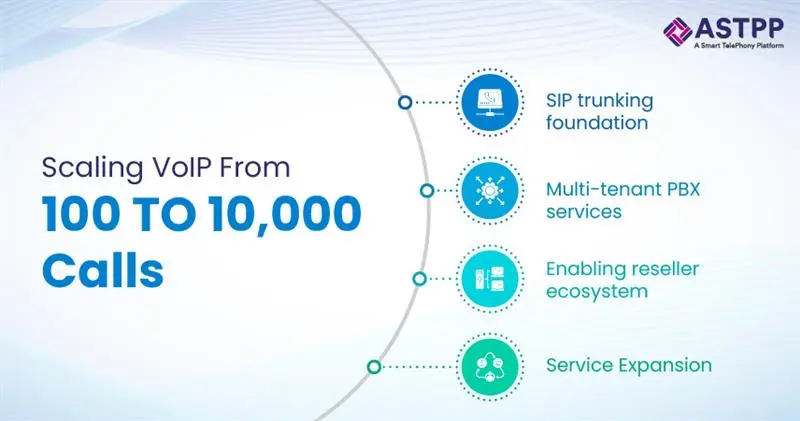
Ready to master how to scale VoIP business? Follow this actionable plan for flawless VoIP concurrent call handling:
- Build SIP trunking foundation: Start strong with reliable trunks and tools like FreeSWITCH, so your base handles 100+ calls steadily before growth hits.
- Add multi-tenant PBX services: Next, layer in PBX (e.g., Asterisk) with LCR routing, which boosts capacity to thousands while isolating tenants seamlessly.
- Enable reseller ecosystem: Then, onboard partners via white-label portals, creating recurring revenue as they drive more VoIP concurrent call handling volume.
- Expand services: Finally, roll out softphones, FoIP, and AI bots, diversifying streams and pushing past 10,000 calls effortlessly.
Test at each step for under 1% drop rate, scale smart!
Advanced Features for Large-scale VoIP Operations

At 10,000+ calls, telecom infrastructure demands pro-level tools. Here’s what powers elite VoIP load balancing and beyond:
- VoIP load balancing: Distributes traffic evenly via OpenSIPS or Kamailio, preventing hotspots. As a result, no single server buckles under peaks.
- VoIP failover: Auto-switches to backups seamlessly during failures. This keeps calls flowing 24/7, minimizing downtime in mission-critical call centers.
- Fraud detection: AI flags threats like SIM boxes and anomalies instantly. Consequently, it blocks threats before they leak revenue.
- Third-party integrations: Connect CRM (Vtiger/Salesforce), billing, and AI bots effortlessly. Thus, data flows unify operations for faster scale VoIP business.
Together, these ensure rock-solid VoIP infrastructure scaling.
Why ASTPP Is Built For VoIP Scaling
ASTPP excels as a scalable VoIP platform and a complete VoIP business solution, powered by its advanced VoIP billing software.
Its unified platform combines billing, routing, and CRM into one seamless system, so data silos disappear and daily operations run smoothly without constant fixes.
Meanwhile, its modular architecture makes growth easy. You add features like reseller portals or AI bots as needed, scaling up without expensive full rebuilds. With proven scalability that handles 10,000+ concurrent calls via reliable clusters, providers from startups to enterprises trust ASTPP for rock-solid VoIP scaling and a true VoIP business solution.
Conclusion:
Mastering how to scale VoIP business starts with the right VoIP growth strategy. By tackling VoIP scaling challenges and leveraging tools like ASTPP, you’re now equipped to grow from 100 to 10,000 calls seamlessly.
Ready to scale VoIP business without downtime or revenue loss?


